
I grew up eating my grandmother’s rfissa, grabbing msemmen from the same street vendor every morning on the way to school, and watching mechoui cooked in clay pits at family weddings long before I ever thought about writing any of it down.
Today, I run tours across Morocco and still believe the best way to understand Moroccan food is through what people cook and how they share it. Everything in this guide comes from a lifetime of eating at home, not from a holiday.
What Should You Try First?
If you only have three days and want to eat well, start with chicken tagine with preserved lemon and olives (available everywhere, reliably excellent), grab msemmen from a street vendor each morning, and end your trip with pastilla at a proper riad dinner.
Those three dishes alone will teach you more about Morocco’s flavour logic than any cookbook can.
The Day Pastilla Changed How I Think About Food
Three years ago, on my first evening in Marrakech, someone slid a slice of pastilla across the table without explanation. It was dusted with powdered sugar. There was cinnamon on top.
I assumed it was dessert. The first bite of crisp pastry, spiced chicken, soft almond, and sweet sugar made me stop eating and just think for a moment.
That contrast between sweet and savoury was not an accident. It was a reflection of how Moroccan cooks think. Layering is the logic.
Slow cooking is the method. And the balance between opposites, sweet and salty, crisp and soft, earthy and bright, is the consistent goal.
This guide covers nine dishes that every visitor to Morocco should try. Each one belongs to a different context: some are street food, some are feast foods, and some are home foods that rarely make it to restaurant menus. All of them are worth going out of your way to find.
| Dish | Region | Occasion | Flavour Profile | Best Paired With |
|---|---|---|---|---|
| Chicken Pastilla | Fes / Nationwide | Celebration, feast | Sweet, savoury, warm spices | Mint tea |
| Tanjia Marrakchia | Marrakech | Every day, Friday lunch | Deep, meaty, citrusy | Crusty bread |
| Veal Tagine with Prunes & Almonds | Nationwide | Family meals, occasions | Sweet, savoury, aromatic | Couscous or khobz bread |
| Rfissa | Nationwide | Family gatherings | Earthy, herbal, warming | Trid flatbread |
| Chicken Tagine Preserved Lemon & Olives | Nationwide | Everyday lunch | Bright, salty, gentle | Couscous or rice |
| Seafood Pastilla | Casablanca, coastal cities | Celebratory lunch | Savoury, citrusy, crisp | Mint tea, simple salad |
| Mechoui | Nationwide | Weddings, Eid | Smoky, simple, tender | Bread, cumin, harissa |
| Chermoula Sardines | Coastal cities | Street food, lunch | Bold, herbal, tangy | Crusty bread, lemon |
| Msemmen | Nationwide | Breakfast, tea time | Flaky, buttery, versatile | Honey, argan oil, or stew |
Flavour Profile Chart
| Dish | 🍯 Sweet | 🧂 Savory | 🌶 Spiced | 🌿 Herbal | 🔥 Smoky |
|---|---|---|---|---|---|
| Chicken Pastilla | ★★★★☆ | ★★★☆☆ | ★★★☆☆ | ★☆☆☆☆ | ★☆☆☆☆ |
| Tanjia Marrakchia | ★☆☆☆☆ | ★★★★★ | ★★★☆☆ | ★★☆☆☆ | ★★★☆☆ |
| Veal Tagine Prunes | ★★★★☆ | ★★★★☆ | ★★★☆☆ | ★☆☆☆☆ | ★☆☆☆☆ |
| Rfissa | ★★☆☆☆ | ★★★★☆ | ★★★★☆ | ★★★☆☆ | ★☆☆☆☆ |
| Chicken Tagine Lemon | ★★☆☆☆ | ★★★★★ | ★★★☆☆ | ★★☆☆☆ | ★☆☆☆☆ |
| Seafood Pastilla | ★★★☆☆ | ★★★★☆ | ★★★☆☆ | ★★★☆☆ | ★☆☆☆☆ |
| Mechoui | ★☆☆☆☆ | ★★★★★ | ★★☆☆☆ | ★★☆☆☆ | ★★★★★ |
| Chermoula Sardines | ★☆☆☆☆ | ★★★★☆ | ★★★☆☆ | ★★★★★ | ★☆☆☆☆ |
| Msemmen | ★★★☆☆ | ★★★☆☆ | ★☆☆☆☆ | ★☆☆☆☆ | ★☆☆☆☆ |
When to Order Each Dish
| Dish | ☀️ Breakfast | 🕛 Lunch | 🌙 Dinner | 🎉 Celebration | 🏪 Street Food |
|---|---|---|---|---|---|
| Chicken Pastilla | — | ✓ | ✓✓ | ✓✓ | — |
| Tanjia Marrakchia | — | ✓✓ | ✓ | — | ✓ |
| Veal Tagine Prunes | — | ✓ | ✓✓ | ✓✓ | — |
| Rfissa | — | ✓ | ✓ | ✓✓ | — |
| Chicken Tagine Lemon | — | ✓✓ | ✓ | ✓ | — |
| Seafood Pastilla | — | ✓✓ | ✓ | ✓ | — |
| Mechoui | — | ✓ | ✓ | ✓✓ | ✓ |
| Chermoula Sardines | — | ✓✓ | ✓ | — | ✓✓ |
| Msemmen | ✓✓ | — | — | ✓ | ✓✓ |
The 9 Dishes in Full
Chicken Pastilla (Pastilla au Poulet)
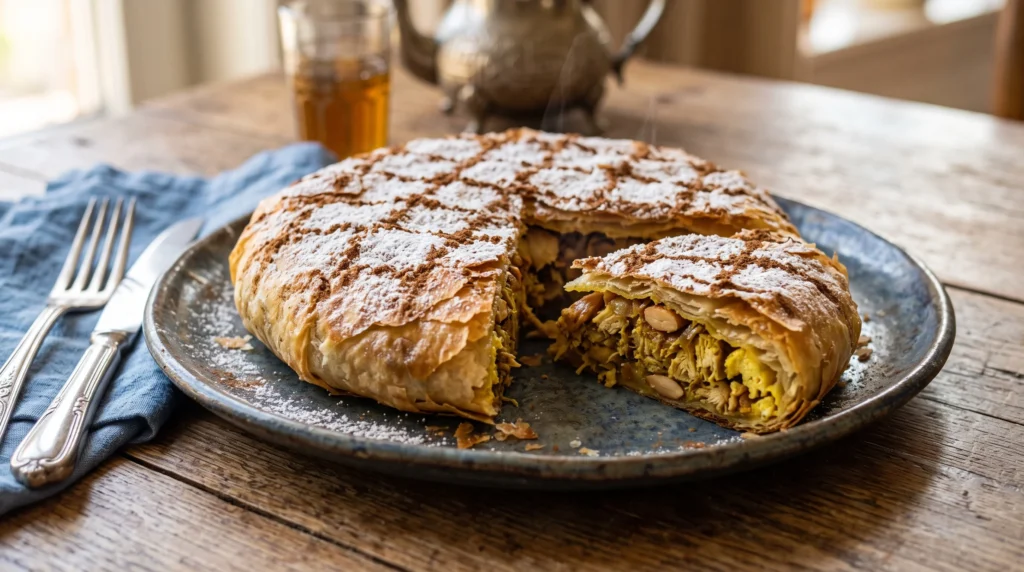
The powdered sugar on top looks like a mistake the first time.
Press a fork through the paper-thin pastry, release the steam from the spiced chicken inside, and taste a single forkful with the sugar and cinnamon dusted across the top, and the logic becomes immediately clear.
Sweet does not compete with savoury here. It completes it.
Pastilla is a layered pie of remarkable technical skill.
The outer shell is made from warqa, a traditional Moroccan pastry leaf thinner than phyllo, made by dabbing wet dough across a hot surface in overlapping circles. Inside: braised chicken pulled from the bone and mixed with saffron-laced eggs, toasted almonds, cinnamon, and sugar.
The whole thing is baked or fried until the shell is golden and has a crisp, audible texture.
The dish originated in Morocco’s imperial cities, with Fes holding the strongest historical claim.
Its roots trace back to Arab and Andalusian culinary influences that came into Morocco during the 15th century, a heritage that still shapes how cooks in the medinas of Fes and Meknes approach the sweet-savoury balance.
Pastilla today remains the centrepiece of feast cooking: weddings, family celebrations, and formal riad dinners.
Sam’s honest tip: If a restaurant serves you pastilla in under twenty minutes, it was reheated from frozen. The real thing takes hours to assemble properly. Order it somewhere it is listed as a house speciality, not an afterthought.
Tanjia Marrakchia (Pit Baked Bachelor’s Stew)
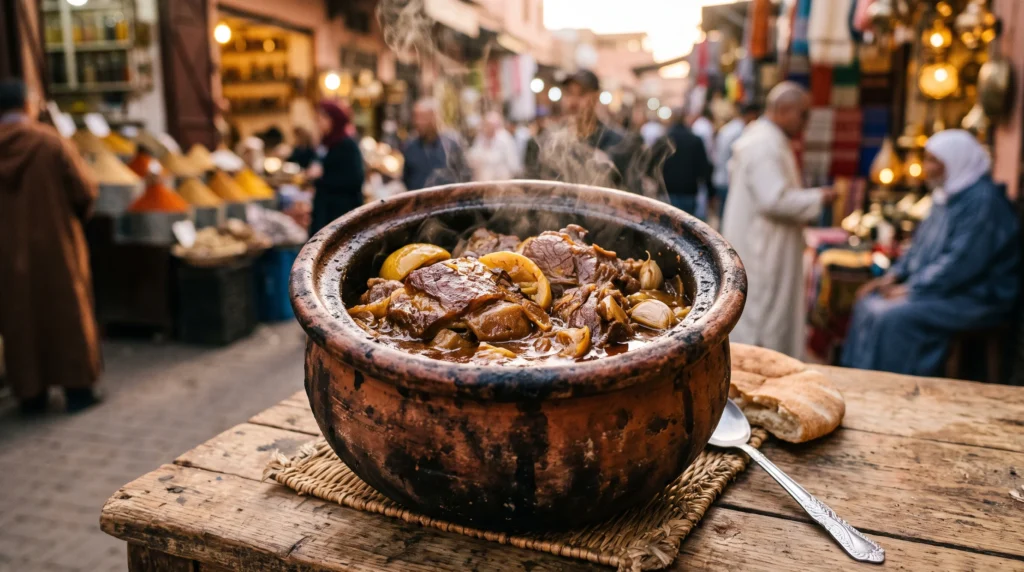
The slow-cooked dish that Marrakech men have made for centuries, and still make the same way
Tanjia does not look like much when it arrives.
It comes in the same squat clay urn it was cooked in, sealed earlier in the morning with paper and twine, then carried to the furnace of the local hammam, where the vessel sits in the hot coals for six to eight hours while the cook goes about his day.
That is the entirety of the technique. Time does all the actual work.
Lamb or beef, the tougher, cheaper cuts preferred, goes into the urn with preserved lemon, whole garlic cloves, a pour of argan oil, cumin, saffron, and a pinch of smen (aged fermented butter). Nothing else.
What happens a few hours later is extraordinary: meat that shreds apart at the touch of a spoon, a cooking liquid reduced into something rich and almost jammy, and a background citrus note from the preserved lemon that has completely lost its sharpness.
The dish carries a specific cultural identity in Marrakech.
Tanjia was historically made by working men, labourers, and craftsmen who could seal their pot in the morning, leave it at the hammam furnace, and collect it at lunchtime without needing a kitchen.
That practical origin is part of why locals call it “the bachelor’s stew”. In the souks near Jemaa el Fnaa today, small tanjia restaurants still operate at lunch, and the pots typically sell out by early afternoon.
Sam’s honest tip: Walk away from the main square into the side streets near the tanneries. The serious tanjia vendors are tucked in there, and the prices are a fraction of what the tourist-facing restaurants charge.
Veal Tagine with Prunes & Almonds
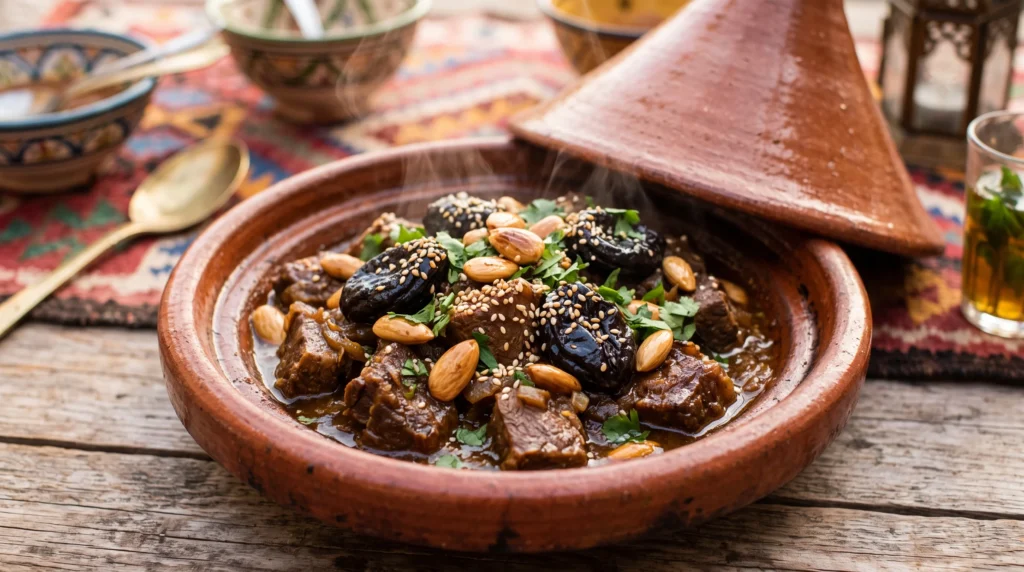
(This Image is Just For Illustrative Purpose Only)
The sweet-savoury tagine that defines celebratory Moroccan cooking
Ask a Moroccan family what they cook for a special occasion, and the answer, more often than not, involves a tagine of meat with dried fruit and toasted nuts.
This combination, with veal, prunes, and almonds, is one of the most classic versions and represents something fundamental in Moroccan culinary thinking: that richness should come from depth and balance, not from heat or intensity.
The veal braises under the conical tagine lid for at least two hours.
The lid’s shape is not decorative; it circulates steam back down over the meat continuously, keeping it from drying out while concentrating the sauce beneath.
Cinnamon, ginger, turmeric, and a spoon of honey give the sauce its warmth.
The prunes dissolve into it completely, lending a dark, jammy sweetness. The almonds, blanched, peeled, and toasted to a deep gold, are pressed across the top just before serving.
Eat this with a torn piece of Moroccan khobz bread to drag through the sauce.
Or serve it over a mound of fine, hand-rolled couscous to absorb the liquid completely.
The dish appears at family lunches on Sundays, at Eid celebrations, and at any occasion where the cook wants to express care and effort through food.
A note on the sweet-savoury tradition:
This flavour combination is not unique to Morocco, but it is more deeply embedded here than almost anywhere else in the Arab world.
Food historians trace it to the Moorish cooks of Al-Andalus, mediaeval Islamic Spain, whose culinary manuscripts describe nearly identical preparations of meat, dried fruit, and spice.
Rfissa (Fenugreek Chicken Trid)
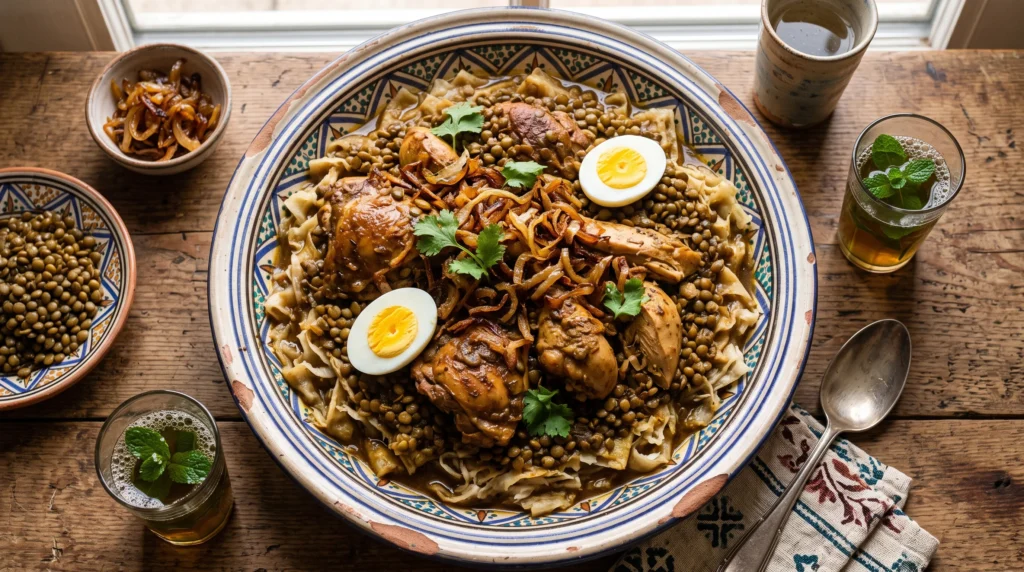
(This Image is Just For Illustrative Purpose Only)
A dish tied to family, tradition, and the kind of cooking that rarely makes it to restaurant menus
Rfissa rarely photographs well. It is brown, brothy, and rustic in a way that does not lend itself to a beautiful plate. None of that matters once you taste it.
Slow-cooked chicken and earthy lentils are ladled over a base of shredded trid flatbread, a disc of thin, layered pastry similar to msemmen that has been torn into pieces and arranged in a wide communal bowl.
The hot broth pours down through the bread until every piece is saturated.
The result is somewhere between a stew and a bread pudding: deeply savoury, warming, and filling in a way that stays with you for hours.
The key flavours here come from three ingredients that define rfissa’s character: fenugreek seeds (bitter and aromatic, with a warmth that sits at the back of the throat); saffron (golden and slightly floral); and ras el hanout, a spice blend that serious Moroccan spice merchants blend themselves, with formulas that can include anywhere from twelve to thirty individual spices.
Rfissa carries a strong cultural meaning. In Morocco, it is the dish made for women after childbirth.
Fenugreek is traditionally understood to support recovery and milk production, and the rich broth is considered nourishing in a medicinal sense.
Beyond that context, it appears at large family gatherings whenever a cook wants to feed a crowd something that takes real time and care. Eating it in a restaurant is possible but uncommon in its best form.
Sam’s honest note: If you are ever invited to eat rfissa in a Moroccan home, say yes without hesitation. It is one of the experiences that distinguishes a real visit to Morocco from a tourist one.
Chicken Tagine with Preserved Lemon & Olives
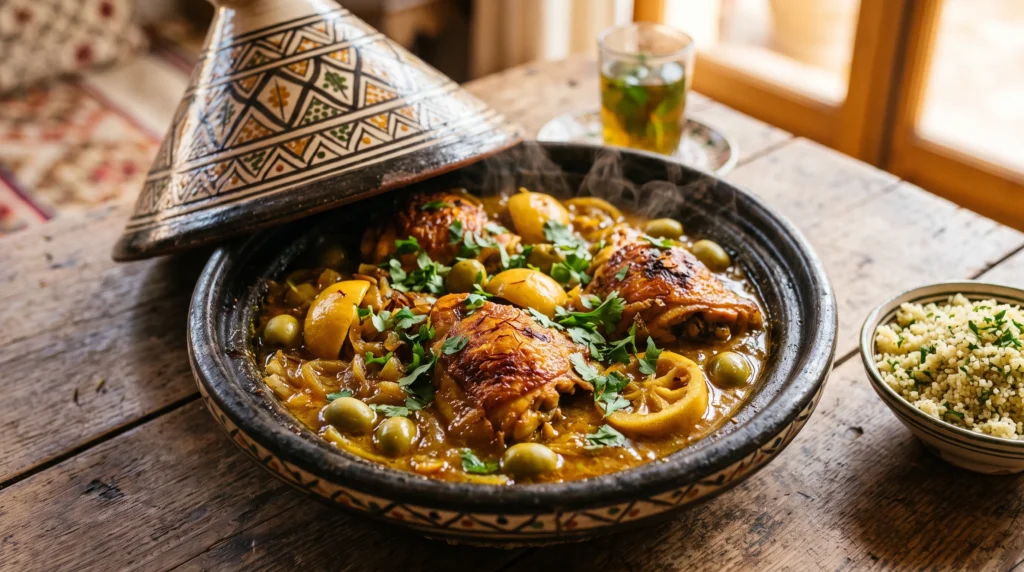
(This Image is Just For Illustrative Purpose Only)
The everyday tagine that tells you everything important about Moroccan home cooking
Of all the tagines on this list, this is the one to order first. Not because it is the most intense, but because its gentleness is what makes it informative.
Simple ingredients, careful technique, and one key element, preserved lemon, transform everything around it.
Chicken thighs braise slowly in a base of onion, saffron, turmeric, and cumin, developing a golden-coloured sauce with a soft, deep warmth.
Green olives go in during the final thirty minutes, lending a slight bitterness that cuts through the richness. The preserved lemon, added in strips, rind and all, is the defining element. Lemons preserved in salt for at least four weeks lose their sharpness entirely.
What remains is pure, concentrated lemon character: mellow, almost floral, deeply savoury in a way that fresh lemon cannot replicate.
The dish is simple to make and genuinely hard to tire of. It appears at Moroccan lunch tables multiple times a week without anyone complaining.
Serve it over couscous or plain rice so the sauce is fully absorbed, or eat it straight from the tagine with torn bread.
When to order it: This is the tagine to order at a traditional riad for lunch. It is almost always available, and the small variations between restaurants, a little more saffron here, more olives there, are genuinely interesting once you know what to look for.
Seafood Pastilla
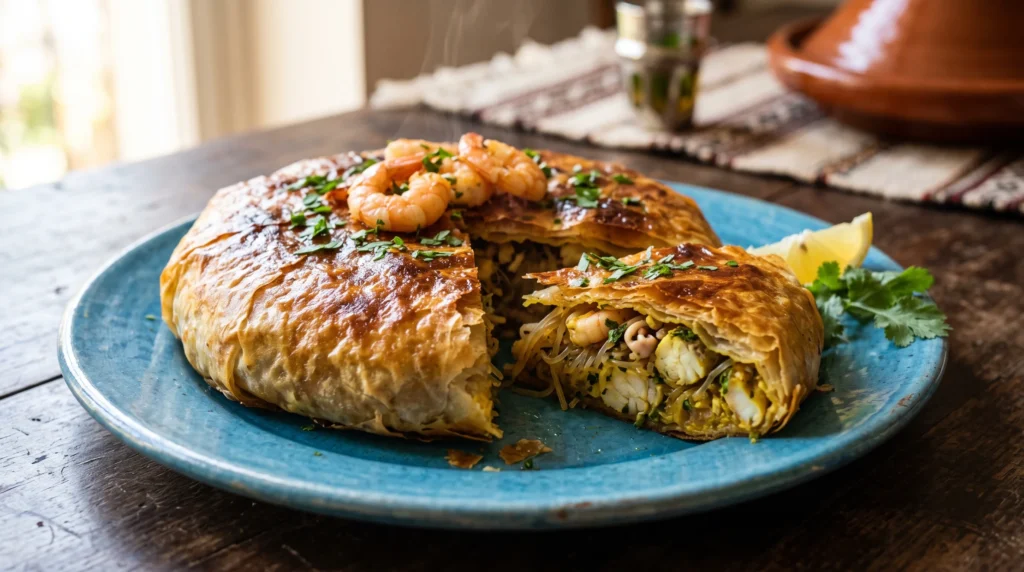
(This Image is Just For Illustrative Purpose Only)
Morocco’s Atlantic coast reimagined inside a crispy, layered pie
Travel northwest from the mountains, and the food shifts noticeably. Lamb gives way to fish. Ras el hanout gives way to chermoula.
The Atlantic sits just outside most restaurant windows, and the morning catch determines what is on the menu by noon.
Seafood pastilla applies the logic of the classic chicken pastilla to the ocean’s produce, and the result is one of the most satisfying dishes on the Moroccan coast.
Warqa pastry wraps around a filling of spiced fish, shrimp, or a combination of both, layered with toasted almonds, fresh coriander, ginger, and lemon.
The top is dusted with cinnamon and powdered sugar, the same sweet-savoury contrast that defines the original.
The textures are excellent: the shattering crunch of the warqa, the flakiness of fresh fish, the crunch of the almonds, the brightness of the lemon cutting through the richness of the pastry.
Eat it warm, with a glass of freshly squeezed orange juice or mint tea on the side.
Where Sam recommends eating it:
Essaouira is the best single city for seafood pastilla. The port supplies restaurants by 7 am; the fish is as fresh as it gets, and the cooks here have been preparing it for generations.
Casablanca and Agadir are both excellent alternatives, particularly in seafood-focused restaurants near the harbour areas.
Mechoui (Pit Roasted Lamb)
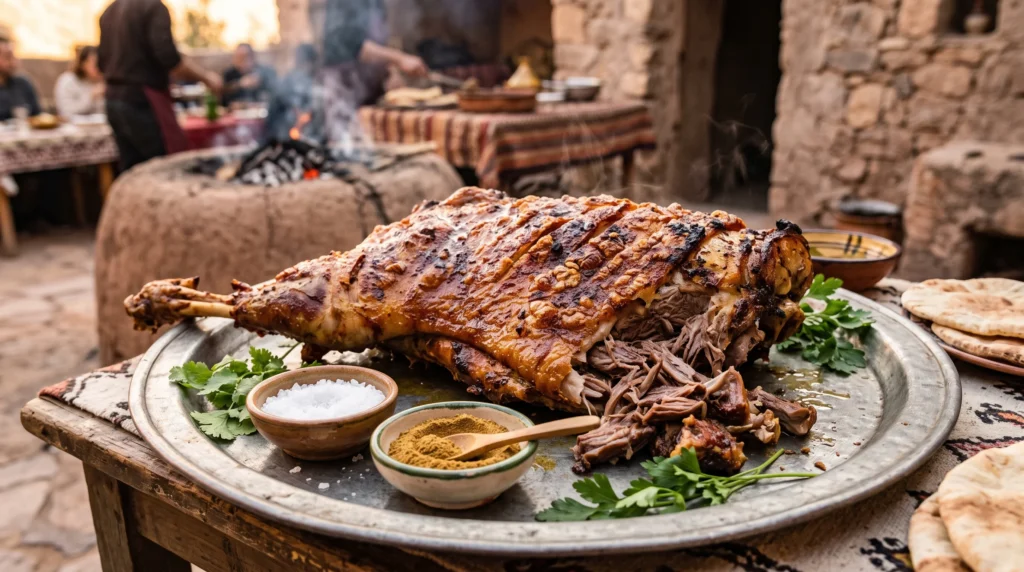
(This Image is Just For Illustrative Purpose Only)
The centrepiece of Moroccan celebration, cooked the slow way
Some dishes require patience as an ingredient. Mechoui is one of them, and the patience is entirely the cook’s responsibility, not yours.
A whole lamb rubbed all over with coarse salt, ground cumin, and butter worked into the skin goes into a clay-lined pit or a specialist clay oven called a ‘ferran’ early in the morning.
The fire is built low and steady. For four to six hours, the lamb sits surrounded by consistent, radiant heat. The skin darkens and crisps into a shell. The fat renders slowly through the meat.
The collagen in the connective tissue breaks down completely.
By the time mechoui is ready, the meat separates at the touch of a fingernail. The shoulder falls apart in your hands.
The neck, the best cut, in Sam’s opinion, is unctuous and deeply flavoured in a way that well-cooked lamb rarely is. Season each piece with a pinch of coarse salt and ground cumin at the table.
Mechoui belongs to Morocco’s major celebrations: weddings, the feast of Eid al-Adha, and large family gatherings.
It is communal food in the most direct sense; a whole animal feeds a crowd, and eating is done by hand, gathered around the meat with bread and fresh herbs.
Finding it as a visitor: Marrakech’s Djemaa el-Fnaa has small mechoui stalls near the northern edge of the square.
Ask for shoulder or neck portions, sold by weight. Arrive before 1 pm; it sells out.
Chermoula-Stuffed Fried Sardines
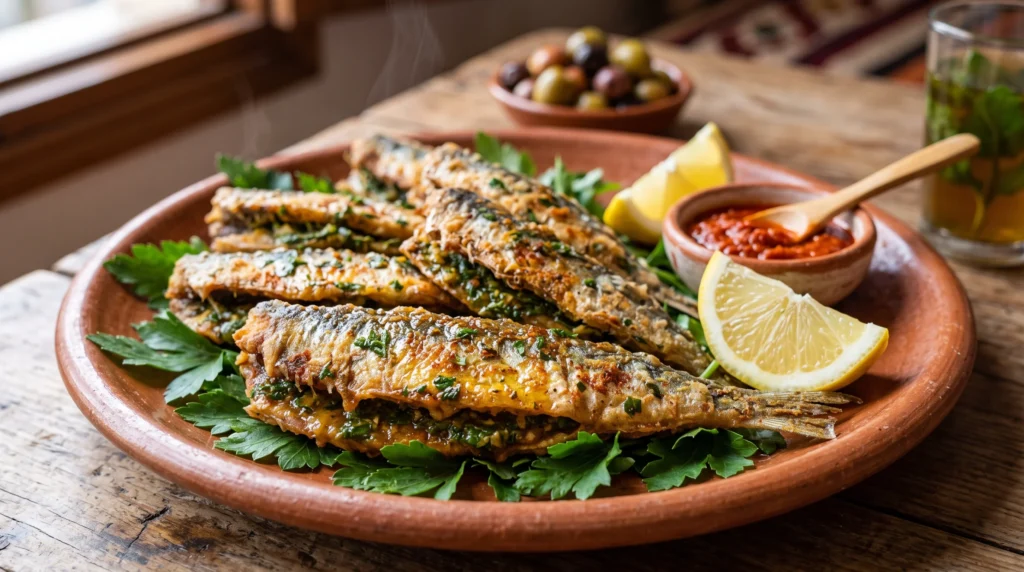
(This Image is Just For Illustrative Purpose Only)
The most direct food in Morocco, made with five ingredients and a hot pan
Sardines are Morocco’s most abundant fish, and along the Atlantic and Mediterranean coasts, cooks have been preparing them the same way for generations. The technique is not complicated. The result is remarkable.
Fresh sardines are butterflied, opened flat, have their backbone removed and are packed with chermoula.
The chermoula here is the version used specifically for fish: cilantro, flat-leaf parsley, garlic, cumin, sweet paprika, fresh lemon juice, and olive oil are pounded or blended into a bright, punchy paste.
The sardine is pressed back together around the filling and fried in hot olive oil until the skin blisters and crisps and the flesh firms up around the herb centre.
The flavours are completely direct. There is no subtlety to manage, no complex spice layering to decode. The sardine is rich and oily. The chermoula is sharp, herbal, and acidic.
The crisp skin provides the texture. Eat them with crusty bread, a squeeze of lemon, and harissa on the side.
Where to find them: The harbour area of Essaouira and the fish market at Agadir port are both excellent.
The rule is simple: the closer you are to the boats, the better the sardines.
Markets and harbour stalls that supply restaurants directly will always outperform tourist-facing beach restaurants.
Msemmen (Laminated Street Pancake)
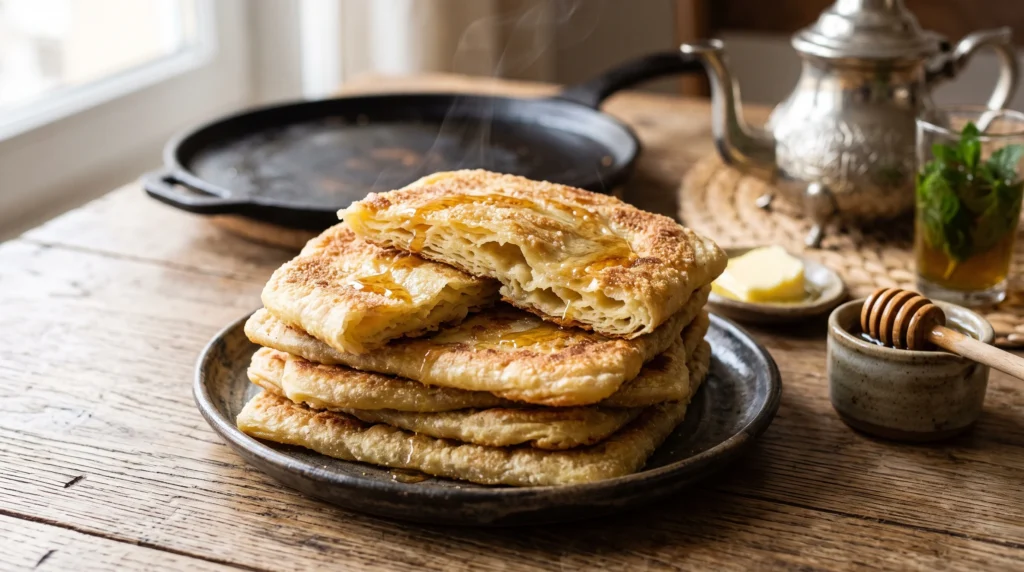
(This Image is Just For Illustrative Purpose Only)
The flatbread that starts every Moroccan morning and sometimes ends the evening too
Stand on almost any street corner in any Moroccan city before 9 am, and there will be someone making msemmen.
The cook works fast and without apparent effort: dough stretched and folded with semolina and oil until it forms distinct, thin layers, then pressed flat on a griddle and cooked until the outside is golden and the centre is soft and steaming.
Pulled apart while still warm, msemmen separates into thin, flaky sheets with a slightly chewy interior and a faintly crisp surface.
Eat it plain, and it is already excellent. Pour argan oil across it and add a spoonful of dark honey, and it becomes one of the genuinely great breakfasts on earth.
Spread it with amlou, a traditional paste of ground almonds, argan oil, and honey made in the Souss region, and you will understand why Moroccans eat it every morning without getting bored.
Msemmen has a second life at the dinner table. Shredded and soaked in the spiced broth of Rfissa, it becomes the base for one of Morocco’s most nourishing dishes.
The same flatbread that starts the day light and sweet becomes, by evening, something hearty and deeply filling.
Sam’s recommendation: Buy semen from a street stall, not a hotel buffet.
The difference in quality is significant, and the price is usually a few dirhams at most.
Watch the cook make it fresh. The technique is genuinely worth seeing.
Key Moroccan Spices Referenced in This Guide
| Spice / Ingredient | Flavour Character | Most Common Use |
|---|---|---|
| Ras el hanout | Complex, warm, aromatic (12 to 30 spices) | Slow-cooked meats, rfissa, tagines |
| Saffron | Floral, golden, gently bitter | Chicken tagines, rfissa, tanjia |
| Preserved lemon | Mellow, citrusy, deeply savoury | Tagines, chermoula, marinades |
| Fenugreek | Slightly bitter, nutty, warming | Rfissa |
| Cumin | Earthy, warm, slightly sharp | Mechoui, chermoula, street seasoning |
| Cinnamon | Sweet-warm, aromatic | Pastilla, tagines with fruit |
| Chermoula (blend) | Herbal, citrusy, sharp | Fish marinades and stuffings |
| Argan oil | Nutty, rich, distinctive | Amlou, tagines, breakfast |
| Smen | Fermented, rich, funky | Tanjia and couscous dishes |
Frequently Asked Questions
What is the most popular dish in Morocco?
Tagine is the most internationally recognised Moroccan dish. Inside Morocco, couscous arguably holds equal or greater cultural importance.
The Friday family couscous is a weekly tradition across the country, from urban apartments to rural villages in the Atlas Mountains.
Is Moroccan food very spicy or hot?
Moroccan food is heavily spiced but not typically hot in the chilli sense.
The dominant spices cinnamon, saffron, cumin, ginger, and ras el hanout add warmth and complexity rather than heat. Harissa (a chilli paste) is served as a condiment on the side at many restaurants, allowing visitors to control their own heat level.
What is the difference between tagine and couscous?
‘Tagine’ refers both to the conical clay cooking vessel and to the dish prepared in it, typically slow-cooked meat, fish, or vegetables in a spiced sauce.
Couscous is a separate dish: steamed semolina grains served with a meat-and-vegetable stew on top. Both use slow cooking and similar spice profiles, but they are distinct preparations for different occasions and textures.
What is warqa pastry, and is it the same as phyllo?
Warqa (also written as ‘ouarka’ or ‘warka’) is a traditional Moroccan pastry leaf, made by repeatedly dabbing wet dough across a hot griddle in overlapping strokes.
The result is thinner and crispier than phyllo. Outside Morocco, phyllo is commonly used as a substitute in pastilla recipes, and it works well, but warqa has a slightly different texture and a more neutral flavour that lets the filling speak.
Can vegetarians eat well in Morocco?
Yes, with some planning. Strong plant-based options include vegetable tagines with chickpeas, zaalouk (a smoked aubergine and tomato dip), harira soup (typically meat-free in many preparations), bissara (a thick fava bean soup with cumin and olive oil), msemmen with honey and argan oil, and fresh-squeezed juice combinations.
In major cities and areas frequented by international visitors, vegetarian-specific menus are increasingly common.
What are the essential spices in Moroccan cooking?
The core Moroccan spice vocabulary includes cumin, coriander, cinnamon, ginger, turmeric, sweet paprika, saffron, and ras el hanout (a complex blended spice mix).
Beyond spices, preserved lemons and argan oil are essential flavour elements that appear across multiple dish categories and define much of what is distinctive about Moroccan cooking.
What should visitors drink with Moroccan food?
Mint tea atay in Moroccan Arabic is the default pairing for nearly every meal and social occasion.
It is prepared with gunpowder green tea, fresh spearmint, and a substantial quantity of sugar, then poured from a height into small glasses to create a light foam.
Fresh-squeezed orange juice, avocado smoothies (served thick and sweet), and almond milk are also widely available non-alcoholic options.
Morocco is a predominantly Muslim country; alcohol is available at licensed hotels and bars in major cities but is absent from traditional dining contexts.
Is Moroccan food halal?
The vast majority of food served in Morocco is halal as a matter of course.
Pork is not available in traditional Moroccan restaurants.
Visitors following halal dietary requirements will find Morocco straightforward to navigate and will not need to make special requests in most settings.
When is the best time to try Moroccan street food?
Evening is the ideal time, particularly in cities with active night markets.
Djemaa el-Fnaa in Marrakech transforms into one of the world’s great outdoor food markets after sunset, with grilled meats, merguez sausages, snail broth, harira soup, fresh-squeezed juices, and more.
Morning is excellent for msemmen, khobz bread, and bissara from neighbourhood stalls that cater to locals heading to work.
How long does a traditional tagine take to cook?
A properly cooked tagine takes a minimum of one and a half to two hours over low heat.
Lamb tagines often take two to three hours to achieve the right texture.
Tanjia Marrakchia, the most extreme example, cooks for six to eight hours in a hammam furnace.
This long cooking time is not inefficiency; it is the method.
The slow, moist heat inside the conical lid is what makes Moroccan braised meat distinctive.
What is ras el hanout, and what does it taste like?
Ras el hanout means “head of the shop” in Moroccan Arabic. Historically, it was the most complex and expensive spice blend a merchant could offer.
The exact composition varies by maker and region, but a typical blend includes cinnamon, coriander, cumin, ginger, turmeric, cardamom, pepper, and additional warming spices.
The result is deeply aromatic, warm rather than hot, and complex in a way that is hard to describe precisely but easy to recognise.