
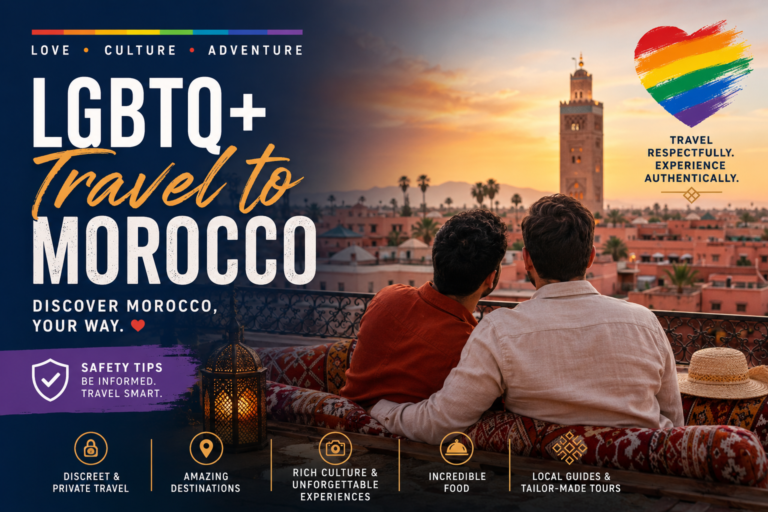
LGBTQ+ Travel to Morocco: 10 Essential Safety Tips & Experiences
Morocco is a country of extraordinary contrasts. From the colorful medinas of Marrakech and Fes to the blue streets of Chefchaouen, the Atlantic coast, the Atlas Mountains and the golden dunes of the Sahara, Morocco offers travelers an unforgettable combination of culture, history, food, landscapes and hospitality.
But for LGBTQ+ travelers, visiting Morocco requires a little more preparation.
Morocco remains a destination where same-sex sexual activity is illegal, and travelers should understand the country’s laws and social environment before arriving. Article 489 of Morocco’s Penal Code criminalizes same-sex sexual activity, with potential imprisonment and fines. Human Dignity Trust reports that the provision applies to both men and women and that enforcement has occurred in recent years. (Human Dignity Trust)
This does not mean LGBTQ+ travelers cannot experience Morocco. Many LGBTQ+ visitors travel through Morocco successfully every year. However, the experience is different from traveling to destinations where LGBTQ+ rights and public expression are legally protected.
The key is to travel informed, respect local customs, protect your privacy and choose your travel arrangements carefully.
Here is what LGBTQ+ travelers should know before planning a Moroccan adventure.
Is Morocco LGBTQ+ friendly?
This is one of the first questions LGBTQ+ travelers ask.
The honest answer is that Morocco is not an LGBTQ+-friendly destination in the same legal sense as countries where same-sex relationships are protected by law.
Same-sex sexual activity remains illegal, and public displays of affection between same-sex couples can create legal and social risks. The UK Foreign, Commonwealth & Development Office currently advises LGBTQ+ travelers that same-sex sexual relations are illegal in Morocco and warns that public displays of affection can lead to prosecution. (GOV.UK)
At the same time, Morocco is a major international tourism destination. Cities such as Marrakech, Casablanca, Fes, Essaouira and Agadir welcome millions of international visitors and have extensive tourism infrastructure.
For LGBTQ+ travelers, therefore, the best approach is not to assume that Morocco is either completely welcoming or completely inaccessible.
Instead, think of Morocco as a destination where cultural sensitivity and discretion are important.
1. Understand Moroccan laws before you travel
Before visiting Morocco, familiarize yourself with the country’s laws.
The most important point for LGBTQ+ travelers is Article 489 of the Penal Code.
According to Human Dignity Trust, the law prohibits same-sex sexual activity and provides for a potential sentence of between six months and three years in prison, together with a fine. (Human Dignity Trust)
This is not simply a historical law that exists on paper. Human Dignity Trust documents arrests and prosecutions in recent years. (Human Dignity Trust)
That makes understanding the legal environment particularly important.
What does this mean for visitors?
It means you should:
Avoid public displays of same-sex affection.
Be cautious with intimate behavior outside private spaces.
Avoid confrontational discussions about sexuality with strangers.
Be careful when using dating applications.
Protect your personal information.
Research your accommodation before booking.
Follow local laws and customs.
Being informed doesn’t mean hiding who you are. It means understanding the environment you’re entering and making decisions that protect your safety.
2. Public displays of affection: keep them private
Holding hands, kissing or openly displaying affection may be normal for LGBTQ+ couples in many countries.
Morocco is different.
The safest approach is to keep romantic affection private, particularly in public places, medinas, religious areas and smaller communities.
This is especially important because a tourist’s behavior can attract attention in busy areas.
Instead of focusing on what you cannot do, concentrate on what makes Morocco special: sharing a meal, exploring a medina together, watching the sunset over the Atlantic, taking a cooking class, visiting historic monuments or enjoying the Sahara.
You can still have an incredibly romantic Moroccan holiday without making public affection part of the experience.

3. Choose your accommodation carefully
Accommodation is one of the most important considerations for LGBTQ+ couples.
Morocco offers everything from international five-star hotels to traditional riads, boutique properties, desert camps and mountain lodges.
When choosing accommodation, look for established properties with strong international reviews and professional management.
For couples, particularly those traveling together for the first time in Morocco, reputable hotels and well-established riads can provide a more comfortable experience.
It is also worth contacting your accommodation before arrival if you have specific concerns about check-in arrangements or privacy.
Riad or hotel?
A traditional riad can be one of the most memorable Moroccan experiences.


Riads are usually smaller and more intimate than large hotels, often centered around a beautiful interior courtyard.
Hotels, particularly international properties, may provide a more standardized experience.
For LGBTQ+ couples who prefer additional privacy and predictable international hospitality standards, a well-reviewed upscale hotel can sometimes be the easier choice.
For travelers looking for atmosphere and cultural immersion, a reputable riad can be wonderful.
4. Be careful with dating apps in Morocco
Dating applications require additional caution.
The FCDO specifically warns that using dating applications in Morocco can carry legal, personal safety and privacy risks. (GOV.UK)
This is one area where LGBTQ+ travelers should be particularly conservative.
If you decide to use a dating app:
Don’t immediately share your hotel name.
Don’t send copies of your passport or identification.
Don’t share your home address.
Be cautious about sharing photographs.
Don’t send money to someone you have never met.
Avoid meeting strangers in isolated locations.
Arrange meetings only in places where you feel secure.
Tell a trusted person where you are going.
Leave immediately if something feels wrong.
The general rule is simple:
Protect your privacy until you have established genuine trust.
5. Travel with a trusted local guide or DMC
One of the easiest ways to make a Moroccan journey more comfortable is to work with a reputable local travel company.
A professional local guide can help with:
Transportation
Accommodation
Restaurant recommendations
Cultural etiquette
Medina visits
Mountain excursions
Sahara journeys
Desert camps
Local experiences
Emergency assistance
Communication with local providers
This can be especially useful for LGBTQ+ travelers who don’t want to spend their holiday worrying about navigating unfamiliar situations.
A good guide should be discreet, professional and respectful of your privacy.
You should also feel comfortable discussing your concerns before your arrival.
6. Choose destinations that match your travel style
Morocco is incredibly diverse, and different destinations offer different experiences.
Marrakech
Marrakech is often the first choice for international visitors.


The city combines historic palaces, gardens, souks, restaurants, riads and luxury hotels.
For LGBTQ+ Travel to Morocco, staying in a reputable property and using a private guide or organized experiences can make exploring the city easier.
Fes
Fes is one of Morocco’s great cultural destinations for LGBTQ+ Travel to Morocco.
Its historic medina, traditional crafts, architecture and food make it an excellent choice for travelers interested in history and culture.
The medina is best explored with an official local guide, particularly if you want to understand its history rather than simply wander through the narrow streets.
Essaouira


Essaouira is a wonderful option for travelers who want a more relaxed atmosphere.
The coastal city combines:
Atlantic beaches
Seafood
Art galleries
Historic architecture
Boutique hotels
Cafés
Windsurfing and kitesurfing
Beautiful sunsets
It can be an excellent place to slow down after exploring Marrakech or the Sahara.
7. Don’t miss the Moroccan Sahara
For many LGBTQ+ Travel to Morocco, the Sahara becomes the highlight of their Moroccan journey.
Imagine spending the afternoon traveling through the desert, watching the landscape change from rocky plains to enormous dunes, then enjoying sunset before spending the night at a luxury desert camp.


Popular desert experiences include:
Sunset over the dunes
Camel trekking
Luxury desert camps
Stargazing
Traditional dinner
Berber/Amazigh cultural experiences
Sunrise over the Sahara
For LGBTQ+ couples, a private desert journey can also provide more flexibility and privacy than joining a large group.
8. Experience Morocco beyond nightlife
Some LGBTQ+ travelers associate LGBTQ+ travel with nightlife and dedicated bars or clubs.
Morocco is better experienced through its culture, food, landscapes and experiences.
Consider:
Moroccan cooking classes
Learn how to prepare a traditional tagine or couscous and discover the ingredients and techniques behind Moroccan cuisine.
Hammam experience
A traditional hammam can be an interesting cultural experience. Choose a reputable spa or hotel and clarify what type of treatment you are booking for LGBTQ+ Travel to Morocco.
Atlas Mountains


During your LGBTQ+ Travel to Morocco, spend a few days in the High Atlas Mountains, hike through valleys and villages, and enjoy mountain hospitality.
Moroccan architecture
Explore historic palaces, kasbahs, riads, mosques from appropriate public viewpoints and UNESCO-listed historic districts.
Moroccan food
Food can be one of the most enjoyable ways to connect with local culture.
Try:
Tagine
Couscous
Pastilla
Harira
Moroccan salads
Grilled seafood
Fresh fruit
Mint tea
Moroccan pastries
9. Dress respectfully during LGBTQ+ Travel to Morocco
Morocco is generally more relaxed in major tourist areas than many visitors expect, but it remains a culturally conservative country.
Dressing respectfully is particularly important when visiting:
Religious sites
Rural villages
Small towns
Traditional communities
Markets
Family-oriented areas
You don’t need to abandon your personal style.
However, avoiding extremely revealing clothing can reduce unwanted attention and demonstrate respect for local customs.
This advice applies to LGBTQ+ Travel to Morocco and heterosexual travelers alike.
10. Be especially careful in rural areas
Morocco’s major tourist cities can feel very international.
The situation can be different in smaller towns and rural areas.
The FCDO’s general LGBTQ+ Travel to Morocco guidance notes that attitudes can vary considerably between cities and rural areas, and recommends researching local attitudes rather than assuming that conditions are identical everywhere. (GOV.UK)
If you’re planning a LGBTQ+ Travel to Morocco journey through remote parts of Morocco, such as:
The High Atlas
Draa Valley
Anti-Atlas
Sahara
Small mountain villages
consider traveling with a trusted local guide or organized tour.
This isn’t about being afraid of rural Morocco. These areas can be among the most beautiful parts of the country.
It’s about understanding that cultural norms can differ from those in international tourist centers.
Is Morocco safe for gay couples?
There is no simple yes-or-no answer.
Morocco has millions of international visitors every year, and many travelers have wonderful experiences.
However, LGBTQ+ travelers face risks that heterosexual tourists may not encounter because same-sex sexual activity remains criminalized and discrimination and violence against LGBTQ+ Travel to Morocco people have been documented. (Human Dignity Trust)
The best approach is therefore risk-aware rather than fear-driven travel.
For couples, this means:
Do:
Stay in reputable accommodation.
Use professional guides.
Keep affection private.
Protect your personal information.
Research destinations.
Be discreet on social media.
Take dating-app safety seriously.
Purchase appropriate travel insurance.
Keep emergency contacts available.
Avoid:
Public sexual behavior.
Confrontational discussions about sexuality with strangers.
Sharing private information with unknown people.
Accepting invitations to isolated locations from people you have just met.
Taking unnecessary risks for photographs or social media.
Assuming tourist areas are completely exempt from Moroccan law.
What about transgender travelers?
Transgender travelers may undertake additional research before visiting Morocco.
Issues such as passport information, gender markers, appearance, accommodation and access to medication can require individual consideration.
If you take prescription medication, check the rules governing medication before departure and carry appropriate documentation.
For anyone whose appearance or documentation could lead to questions at borders or during travel, consulting your country’s embassy or consulate before departure is sensible.
The FCDO’s general LGBTQ+ travel guidance also recommends checking medication requirements and local healthcare considerations before traveling. (GOV.UK)
Can LGBTQ+ travelers enjoy a honeymoon in Morocco?
Yes, but a Moroccan LGBTQ+ honeymoon should be planned differently from a honeymoon in a destination with full legal recognition of same-sex relationships.
Instead of focusing on public displays of affection, build your honeymoon around privacy, experiences and beautiful surroundings.
Imagine:
Marrakech → Atlas Mountains → Sahara → Essaouira
You could begin with a luxury riad in Marrakech, spend a few nights in the mountains, travel privately to the Sahara, stay in a luxury desert camp and finish beside the Atlantic in Essaouira.
The memories come from the experiences—not from needing to publicly demonstrate your relationship.
A perfect LGBTQ+ Morocco itinerary
For a first visit, consider a 10-day private Morocco journey for LGBTQ+ Travel to Morocco.
Days 1–2: Marrakech
Explore the medina, gardens, palaces and souks.
Enjoy a private Moroccan cooking experience and dinner at a carefully selected restaurant.
Day 3: Marrakech – Ait Ben Haddou – Ouarzazate
Cross the High Atlas Mountains and visit the famous fortified village of Ait Ben Haddou.
Day 4: Ouarzazate – Dades Valley
Discover the Valley of Roses, kasbahs and dramatic mountain scenery.
Day 5: Dades – Todra Gorge – Merzouga
Travel through the spectacular Todra Gorge before reaching the Sahara.
Day 6: Sahara
Enjoy a private desert experience, sunset over the dunes and overnight in a luxury desert camp.
Day 7: Merzouga – Rissani – Draa Valley
Travel through southern Morocco and discover traditional landscapes and villages.
Day 8: Draa Valley – Marrakech
Enjoy the scenery and return to Marrakech.
Days 9–10: Marrakech or Essaouira
Finish your journey with relaxation, shopping, food and cultural experiences.
For travelers with more time, extending the itinerary to Fes and Chefchaouen creates an even richer Moroccan experience.
Responsible LGBTQ+ travel in Morocco
LGBTQ+ Travel to Morocco is not only about what we receive from a destination. It is also about how we interact with local communities.
As an LGBTQ+ traveler in Morocco, responsible tourism means:
Respecting local customs.
Supporting local businesses.
Hiring local guides.
Buying directly from artisans.
Asking before photographing people.
Avoiding intrusive questions.
Respecting religious and cultural spaces.
Not treating local communities as an exotic backdrop.
Understanding that your travel experience and a local LGBTQ+ person’s experience may be very different.
This last point is particularly important.
A foreign visitor may be treated differently from a Moroccan LGBTQ+ person because tourism creates a different social and economic context.
Final thoughts: Should LGBTQ+ travelers visit Morocco?
Morocco is a fascinating destination, but LGBTQ+ travelers should visit with realistic expectations and good preparation.
The country offers extraordinary experiences: ancient medinas, beautiful riads, spectacular mountains, the Sahara Desert, Atlantic beaches, extraordinary food and centuries of history.
But it is equally important to acknowledge that same-sex sexual activity remains illegal and LGBTQ+ travelers should exercise discretion, particularly regarding public affection, dating apps and privacy. (GOV.UK)
The goal isn’t to Travel to Morocco in fear.
It’s to travel intelligently.
Choose reputable accommodation. Work with trustworthy local professionals. Respect Moroccan customs. Protect your privacy. Keep romantic affection private in public spaces. And take the time to experience Morocco for what it really is—a remarkably diverse country with landscapes, traditions and hospitality that can stay with you long after you return home.
For LGBTQ+ travelers who understand the environment and plan accordingly, Morocco can be a deeply rewarding cultural adventure.
Travel respectfully. Travel thoughtfully. And let Morocco surprise you.
Important travel note
Laws and official travel advice can change. This article reflects information available in September 2026, including current UK government travel advice and Human Dignity Trust research. Travelers should check their own government’s latest travel advice before departure. (GOV.UK)
For AFC Morocco Travel, we can say that Morocco is an openly LGBTQ+-friendly destination as much as your espect the Moroccan laws, traditions, culture and customs.