
Moroccan Mountains Worth the Effort: High Routes for Travellers Who Like to Earn the View
When most people picture Morocco, their minds wander directly to the labyrinthine medinas of Marrakech, the intricately tiled riads of Fes, or the sun-bleached, undulating dunes of the Sahara. But look up from almost any vantage point in the country’s interior, and you will see something else entirely: a colossal, jagged spine of stone tearing through the blue sky.
These are the Atlas Mountains—a majestic, multi-tiered world of snow-capped peaks, deep terraced valleys, and ancient mud-brick villages that feel entirely removed from the modern world.
For a certain breed of traveller, a vacation isn’t complete without a challenge. You don’t just want to see a beautiful landscape; you want to work for it. You want the burning in your calves, the thinness of the alpine air, the rhythm of your boots hitting rock, and the incomparable, euphoric rush of standing on a summit that could only be reached through sheer human effort.
In Morocco, the mountains do not give up their secrets easily. The scree fields are steep, the passes are high, and the weather can change from blazing sunshine to a mountain blizzard in a matter of hours. But for those willing to lace up their boots, pack a fleece, and step off the beaten track, the rewards are transcendent.
From the legendary heights of Jebel Toubkal to the wild, uncrowded ridges of the M’goun Massif, let’s explore the high routes of Morocco that are undeniably worth the effort.

Why Trek the Moroccan Atlas?
Trekking in Morocco is vastly different from trekking in Europe, North America, or even the Himalayas. It is an experience deeply intertwined with culture, history, and rugged isolation.
+————————————————————————-+
|THE ATLAS TREKKING EXPERIENCE|
+—————————+———————————————+
| Cultural Immersion | Walk through living history in centuries-old|
| | Amazigh (Berber) villages built of earth. |
+—————————+———————————————+
| Striking Topography | Transition from lush walnut groves to raw, |
| | alpine moonscapes within a single day. |
+—————————+———————————————+
| Exceptional Hospitality | Experience legendary mountain hospitality, |
| | complete with freshly brewed mint tea. |
+—————————+———————————————+
When you hit these trails, you are walking on ancient transhumance routes that have been used by the indigenous Amazigh (Berber) shepherds for thousands of years. You will pass fortified granaries, watch goats defy gravity on near-vertical cliffs, and fall asleep to the sound of rushing mountain rivers.
Furthermore, you are never truly alone out here. The mountain communities are incredibly welcoming, and the logistical infrastructure of a Moroccan trek incorporating licensed local mountain guides, skilled camp cooks, and hardworking muleteers ”means that while the hiking is physically demanding, you are exceptionally well taken care of at the end of every exhausting day.
To get the absolute most out of these formidable ranges, having an expert team handle the intricate logistics is vital. If you are looking for a highly personalized, private expedition tailored to your specific fitness level, Nomadik Morocco specializes in crafting authentic, custom-designed private desert and Atlas trekking tours. Alternatively, if you prefer the shared energy of like-minded explorers, AFC Morocco Travel offers meticulously curated small-group journeys capped at just 12 travellers, ensuring you get deep into the wilderness without the crowds.
-
Jebel Toubkal (4,167m) The Roof of North Africa
We begin with the undisputed giant. Standing proud at 4,167 metres, Jebel Toubkal is the highest peak in Morocco, North Africa, and the entire Arab world. For peak-baggers, it is the ultimate Moroccan prize.
The Route: The Standard Two-Day Trek in Moroccan Mountains
Most trekkers tackle Toubkal via a two-day itinerary starting from the bustling mountain trailhead of Imlil (1,740m), located a comfortable 90-minute drive south of Marrakech.
-
Day 1: Imlil to Toubkal Refuge (3,207m)
- Distance: ~10-12 km
- Elevation Gain: ~1,460m
- Time: 5 to 6 hours
- The trek begins gently, winding through apple orchards and walnut groves, passing the holy shrine of Sidi Chamharouch. Here, the trail transforms from a dirt path into an increasingly rocky, relentless uphill slog along the valley floor, culminating at the twin stone mountain huts (Les Mouflons and the Neltner Refuge) nestled at the base of the summit massifs.
-
Day 2: The Summit Push and Descent
- Distance: ~18 km (including the full descent back to Imlil)
- Elevation Gain/Loss: ~960m gain, ~2,420m loss
- Time: 7 to 9 hours
- An alpine start is non-negotiable. You’ll be woken up in the dark, usually around 4:00 AM, to eat a quick breakfast before stepping out into the freezing, star-filled night with your headlamp illuminating the breath misting before you.
Earning the View
The ascent from the refuge is a stern mental and physical test. The route takes you up a steep, unrelenting scree field known as the South Cirque. In the winter and spring, this section requires crampons and ice axes; in the summer, it is a tiring exercise in taking two steps forward and one step back through shifting volcanic gravel.
As you crest the pass at Tizi n’Toubkal, the wind hits you, and the grade eases slightly. The final ridge leads to the iconic metal tripod structure marking the summit.
The Reward: On a clear morning, as the sun breaks over the horizon, the view from Toubkal is utterly mind-blowing. To the north, the plains of Marrakech fade into a distant haze. To the south, the jagged folds of the Anti-Atlas give way to the vast expanse of the Sahara Desert. You are standing above everything else for thousands of miles.
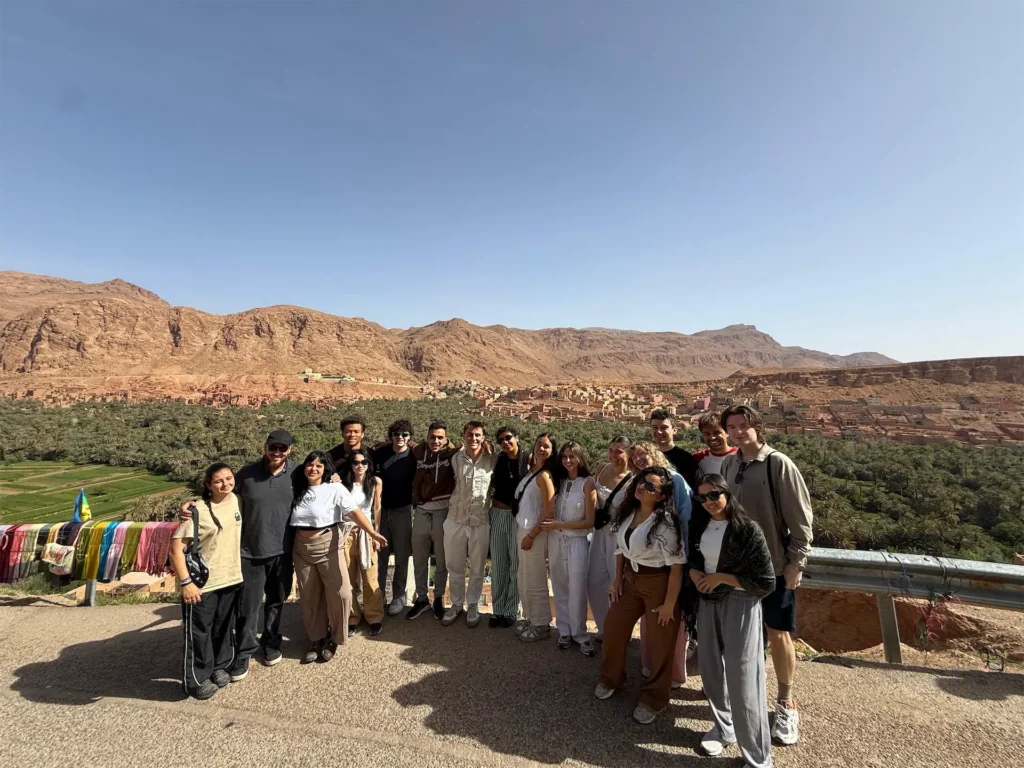
Key Considerations for Moroccan Mountains
Because of its fame, Toubkal can get crowded, particularly during the peak spring and autumn seasons. Additionally, altitude sickness is a very real factor here. Taking time to acclimatize and keeping a slow, steady pace (“Sgued, sgued” as the local guides say) is paramount to making it to the top.
-
The M’goun Massif (4,071m) – The Remote Razor Ridge
If Jebel Toubkal is the popular king of the Atlas, Mount M’goun (also spelled Ighil M’goun) is the wild, untamed challenger. Located in the Central High Atlas, M’goun stands at 4,071 metres, making it Morocco’s second-highest peak. However, it offers a radically different experience than Toubkal. It is longer, significantly more remote, and beautifully uncrowded.
The Route: The Ait Bouguemmez Traverse (5 to 7 Days)
You cannot easily climb M’goun in a weekend. An expedition here typically requires a minimum of five days, often starting from the breathtaking Ait Bouguemmez Valley, affectionately known as the “Happy Valley” due to its lush green fields, vibrant fruit orchards, and famously welcoming inhabitants.
- The Approach: You will spend two to three days trekking through red-earth Amazigh villages, crossing high passes like Tizi n’Ait Imi (2,905m), and walking alongside local nomads who graze their sheep and camels on the high alpine herb meadows.
- Base Camp: You will establish a camp on the dramatic Tarkeddit Plateau (approx. 2,900m), a vast, windswept limestone shelf that feels like the edge of the earth.
- Summit Day: The climb up M’goun is less about steep scrambling and more about an extraordinary, sustained high-altitude ridge walk. The final push involves walking along a narrow, exposed knife-edge ridge at or above 4,000 metres for several kilometres.
Earning the View
The ridge walk on M’goun is spectacular. With steep drop-offs on either side, you feel as though you are walking a tightrope across the sky. The wind can roar fiercely across this exposed limestone crest, demanding total focus and steady footing.
The Reward: The panorama from M’goun’s summit cairn is arguably superior to Toubkal’s because of the sheer isolation. You gaze down upon a complex labyrinth of deep, eroded canyons, limestone towers, and hidden valleys. There are no towns or roads visible—just raw, undulating geology stretching out infinitely.

+————————————————————————+
| TOUBKAL VS. M’GOUN: AT A GLANCE |
+———————-+———————–+————————-+
| Feature | Jebel Toubkal | M’goun Massif |
+———————-+———————–+————————-+
| Height | 4,167 metres | 4,071 metres |
| Crowds | High | Very Low |
| Minimum Time Required| 2 Days | 5–7 Days |
| Terrain | Rocky alpine paths, | Limestone ridges, deep |
| | steep scree | gorges, wide plateaus |
| Vibe | Classic peak conquest | Wilderness exploration |
+———————-+———————–+————————-+
The Bonus: The M’goun Gorges
What goes up must come down, and the descent from M’goun offers one of the greatest trekking finales in the world. Instead of simply retracing your steps, a proper M’goun itinerary takes you down through the M’goun Gorges.
Here, you spend a day wading knee-deep through a freezing, crystal-clear river flanked by towering limestone cliffs that rise hundreds of feet above you, narrowing at points to just a few metres wide. It is a sensational, immersive sensory transition from the frozen high-altitude ridge to the refreshing, shaded water world below.
-
Jebel Saghro (2,712m) “ The Volcanic Moonscape”
Not all great high routes require crossing the 4,000-metre threshold. For those looking to trek during the winter months (November to March), when the High Atlas is locked in heavy snow and sub-zero temperatures, the Anti-Atlas range offers an otherworldly alternative.
Jebel Saghro, peaking at Amalou n’Mansour (2,712 metres), is a stark, black-rock volcanic massif that bridges the gap between the fertile valleys of the High Atlas and the barren expanse of the Sahara Desert.
The Route: The Saghro Traverse (4 to 5 Days)
A classic trek cuts directly through the massif, typically starting from N’Kob or Tagdilte. The landscape here looks like something straight out of an American Western movie, reimagined in North Africa.
- The Terrain: You will hike through a dry, Martian landscape of dramatic basalt towers, deep rocky canyons, mesa formations, and hidden, spring-fed oases packed with date palms.
- The Highlights: The trail leads you past the famous Bab n’Ali (Ali’s Gate), two monolithic rock pillars that rise like giant sentinels out of the valley floor.
Earning the View of Moroccan Mountains
Trekking in Saghro is a test of endurance against the elements. The air is dry, the sun can be intense even in winter, and the terrain underfoot is hard, unforgiving volcanic rock. Climbing up to the high passes, such as the Tizi n’Ouarg (2,220m), requires navigating steep, twisting mule paths through jagged rock formations.
The Reward: From the high crests of Jebel Saghro, you look northward to see the snow-covered wall of the High Atlas cutting across the horizon—a brilliant white contrast against the black and orange volcanic desert surrounding you. To the south, the land flattens out into the hazy, alluring emptiness of the pre-Sahara. It is a view steeped in profound silence and vast space.
Cultural Encounters of Moroccan Mountains
Jebel Saghro is the traditional winter home of the Ait Atta tribe, a fiercely independent Amazigh clan known for their resistance against colonial forces. Trekking here gives you the unique opportunity to encounter these nomadic families living in woven goat-hair tents, moving their herds through the canyons in search of water and pasture.
-
Jebel Sirwa (3,304m) “ The Saffron Mountain
Tucked away between the High Atlas and the Anti-Atlas sits an isolated, ancient volcanic massif that remains blissfully ignored by mainstream tourism: Jebel Sirwa. Rising to 3,304 metres, Sirwa is a trekker’s paradise of terraced fields, dramatic rock scrambles, and rich agricultural traditions.
The Route: The Sirwa Loop (4 to 5 Days)
The trek usually kicks off from the village of Taliouine, the undisputed saffron capital of Morocco.
- The Lower Slopes: The initial days take you through stunningly manicured stone-walled terraces where, in late October and early November, the valleys bloom with the delicate purple flowers of the Crocus sativus. Local families rise before dawn to harvest the precious saffron stigmas.
- The Ascent: As you ascend past the villages, the greenery vanishes, replaced by dramatic volcanic plugs, massive granite boulders, and sweeping sheep pastures.
Earning the View of Moroccan Mountains
The true sting in the tail of Jebel Sirwa is the final summit climb. Unlike Toubkal or Saghro, the peak of Sirwa is a dramatic, vertical volcanic plug—a natural fortress of dark rock known as the Sirwa Citadel.
To reach the absolute summit, you must drop your trekking poles and engage in some genuine, hands-on rock scrambling. It requires a good head for heights and steady handholds on the weathered volcanic stone.
The Reward: Once you pull yourself up onto the flat summit platform, the sense of achievement is massive. Because Sirwa stands isolated between the two major Atlas ranges, it acts as the ultimate viewing platform. You enjoy an unobstructed, 360-degree view of the entire Southern Moroccan landscape, with the massive snowy spine of the High Atlas dominates the northern skyline like a frozen tidal wave.
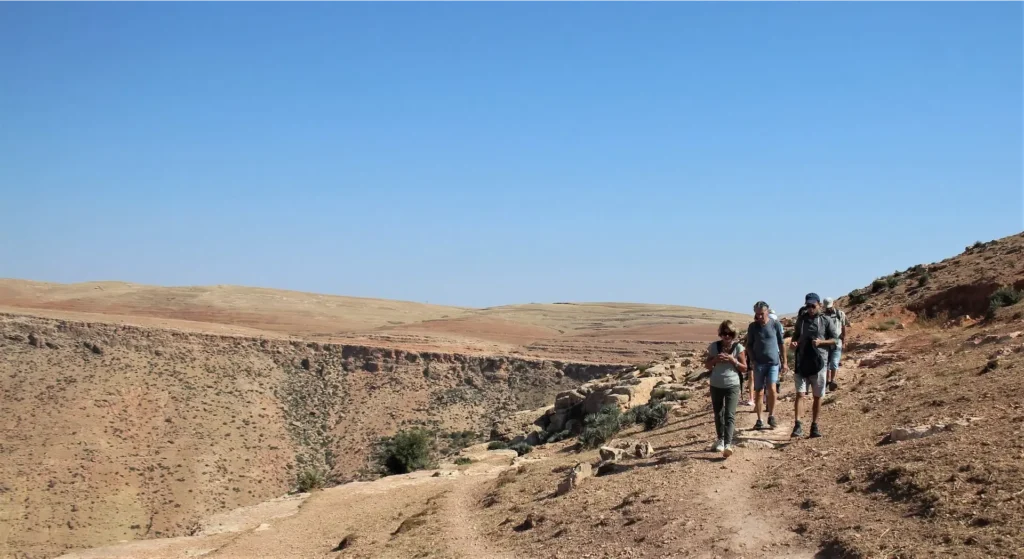
The Human Element: The Secret to Earning the View
While the physical geography of these routes is undeniably spectacular, what transforms a trek in Morocco from a mere physical workout into a deeply moving life experience is the people you share the trail with.
When you book an expedition through professional agencies like Nomadik Morocco or AFC Morocco Travel, you are not just hiring logistical muscle; you are entering into a partnership with an extraordinary team of mountain professionals.
The Mountain Guides
Moroccan mountain guides undergo rigorous training at the national training center in Tabant. They are fluent in multiple languages, deeply knowledgeable about local geology and flora, and possess an innate understanding of mountain safety. More importantly, they are the cultural bridge that helps you connect authentically with the local communities you pass through.
The Muleteers and Cooks Moroccan Mountains
The unsung heroes of the Atlas are the muleteers and cooks. While you carry a lightweight daypack, these hardy locals guide their nimble mules along treacherous paths, arriving at the campsite long before you to set up tents and prepare hot meals.
There is an almost mystical joy in arriving at a windy mountain pass at 3,000 metres, exhausted and cold, to find your cook waiting with a smile, a roaring propane burner, and a freshly prepared lunch of warm Moroccan salad, fresh sardines, and hot mint tea.
The Ritual of “Berber Whiskey”: No matter how brutal the uphill climb was, all hardships dissolve at the end of the day. Sitting in a communal mess tent or a rustic village gite, wrapping your cold hands around a glass of piping hot, sweet gunpowder mint tea—affectionately dubbed “Berber Whiskey”—is a ritual that tastes purely of triumph.
Practical Guide for High-Altitude Moroccan Trekking
To ensure you successfully earn your views rather than succumbing to the challenges of the trail, proper planning and preparation are essential.
When to Go
The ideal trekking window depends entirely on the specific mountain range you plan to conquer:
-
High Atlas (Toubkal / M’goun):
The prime trekking season runs from May to October. During these months, the passes are generally free of snow, though summer afternoons can bring heat to the lower valleys. Winter trekking (November to April) is entirely possible on Toubkal but requires full mountaineering gear, crampons, and winter climbing experience.
- Anti-Atlas & Saghro: The sweet spot is November to March. The weather is pleasantly warm during the day, though temperatures frequently plummet below freezing at night. Summer should be strictly avoided due to extreme, dangerous desert heat.
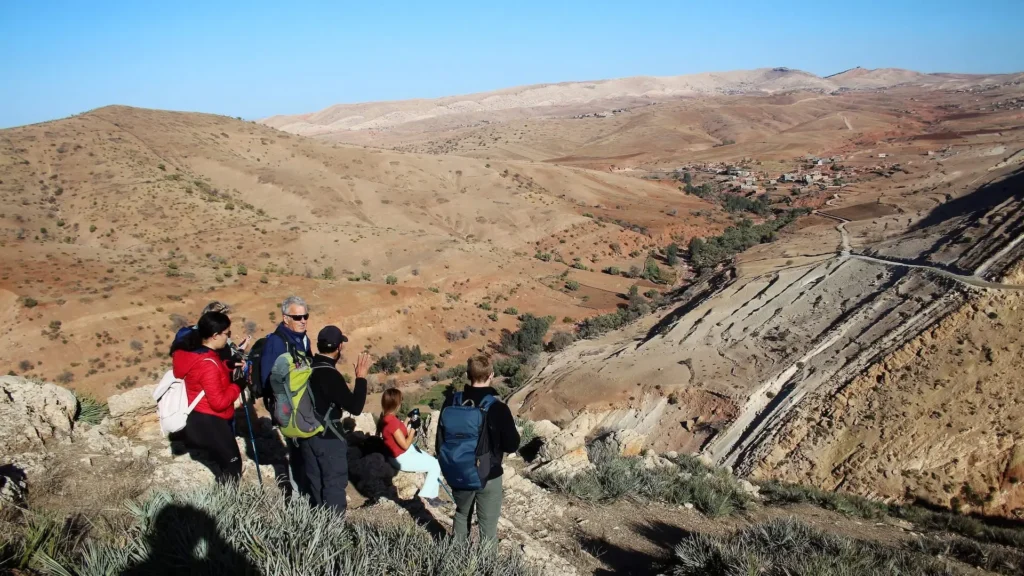
Physical Preparation Moroccan Mountains
Do not underestimate the ruggedness of Moroccan trails. These are not smooth, manicured gravel paths. They are rocky, uneven, mule tracks characterized by significant scree and steep gradients.
- Cardio Endurance: Focus heavily on stair-climbing, hill walking, and running for at least two to three months before your trip.
- Leg Strength: Incorporate plenty of squats, lunges, and calf raises into your fitness routine to prepare your joints for the punishing descents.
- Altitude Awareness: Hydrate aggressively while on the trail. Drink far more water than you think you need, eat plenty of carbohydrates, and never be afraid to slow your pace down to a steady crawl.
Essential Gear Checklist for Trekking in Morocco
While your mules will transport your heavy duffel bags, your personal comfort hinges entirely on what you wear and carry in your daypack:
- Footwear: Sturdy, high-ankle trekking boots with excellent grip are non-negotiable. Ensure they are thoroughly broken in months before you arrive in Morocco to avoid debilitating blisters.
- Layering System: Temperatures fluctuate wildly. You will need a moisture-wicking base layer, a warm fleece mid-layer, an insulated down jacket for frigid evenings/mornings, and a windproof, waterproof hard shell jacket.
- Trekking Poles: An absolute lifesaver for your knees and stability, particularly when sliding down the notorious scree fields of Toubkal or navigating the rocky riverbeds of M’goun.
- Water Purification: Bring a reliable water filter, UV purifier, or purification tablets to treat water along the trail and minimize single-use plastic waste.
Finding Your Perfect High-Altitude Match
Every traveller has a different definition of what makes a view worth earning. Choosing the right route ensures your Moroccan adventure pushes your limits without breaking them.
+————————————————————————+
| WHICH MOROCCAN HIGH ROUTE IS FOR YOU?|
+——————-+——————–+——————————-+
| If your goal is…| …and you want… | Then your ideal peak is… |
+——————-+——————–+——————————-+
| The ultimate badge| A classic alpine | **Jebel Toubkal (4,167m)** |
| of achievement | summit push | |
+——————-+——————–+——————————-+
| Complete isolation| A true multi-day | **M’goun Massif (4,071m)** |
| & wilderness | expedition | |
+——————-+——————–+——————————-+
| Winter adventure | Surreal geologic | **Jebel Saghro (2,712m)** |
| & desert views | volcanic scenery | |
+——————-+——————–+——————————-+
| Off-the-beaten- | Cultural harvest & | **Jebel Sirwa (3,304m)** |
| track scrambling | hands-on climbing | |
+——————-+——————–+——————————-+

Conclusion: The View From the Top
There is an old Amazigh proverb that says: “The mountains do not need the people, but the people need the mountains.”
Standing atop any of Morocco’s great peaks, looking out over a land shaped by tectonic forces, ancient cultures, and the relentless passage of time, it is impossible not to feel a profound sense of humility.
The high routes of Morocco demand a lot from you. They demand early mornings, sweat, sore muscles, and a willingness to step outside your comfort zone. But when you finally stand on those high ridges, watching the sunrise paint the Atlas peaks in shades of gold and crimson, you realize something profound.
You didn’t just see Morocco. You earned it.
Whether you are looking to book a custom, privately-guided trek through the High Atlas valleys with Nomadik Morocco, or join an unforgettable, intimate group expedition with AFC Morocco Travel, the mountains are waiting. Pack your boots, embrace the challenge, and go earn your view.