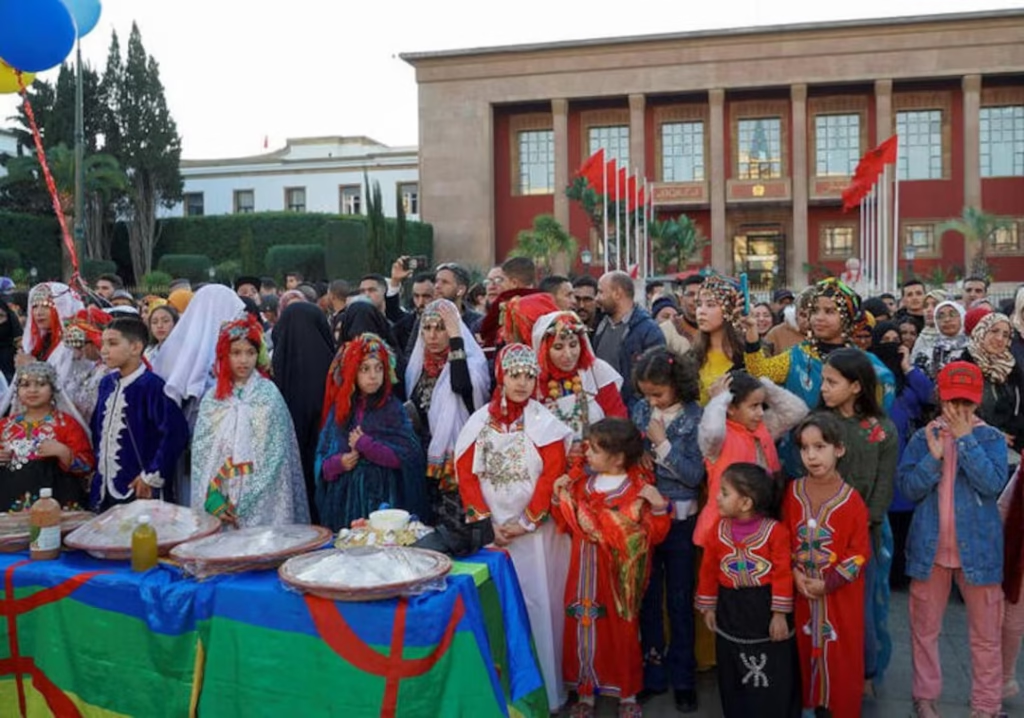
The Amazigh Language and Flag: Discover Morocco’s Rich Indigenous Heritage
The Amazigh people, often referred to historically as Berbers, are the Indigenous inhabitants of North Africa, with a history stretching back thousands of years. Their civilization predates the arrival of the Phoenicians, Romans, Arabs, and Europeans, leaving an enduring cultural legacy that continues to shape the identity of countries such as Morocco, Algeria, Tunisia, Libya, Mali, Niger, Burkina Faso, and beyond.
At the heart of Amazigh culture lies its language—a remarkable linguistic family that has survived centuries of political, cultural, and social change. Alongside the language stands the Amazigh flag, a powerful symbol of unity, resilience, and pride that represents millions of Amazigh people across North Africa and the global diaspora.
This article explores the richness of the Amazigh language family, its diverse dialects, the ancient Tifinagh script, and the deep symbolism of the Amazigh flag, highlighting how language and identity remain inseparable in preserving one of the world’s oldest living cultures.
The Amazigh Language Family: One of the World’s Oldest Linguistic Traditions
The Amazigh language family, commonly known as the Berber languages, belongs to the Afroasiatic language family, which also includes Arabic, Hebrew, Amharic, and Ancient Egyptian. Linguists believe Amazigh languages have been spoken in North Africa for several millennia, making them among the oldest continuously spoken languages in the world.
Unlike a single standardized language, Amazigh is a collection of closely related dialects spoken across an immense geographical region stretching from Morocco’s Atlantic coast to the Egyptian oasis of Siwa and southward into the vast Sahara Desert.
Although these dialects share a common linguistic ancestry, centuries of geographical separation have allowed each to develop its own pronunciation, vocabulary, expressions, and cultural influences. This diversity reflects the equally diverse landscapes inhabited by Amazigh communities—from snow-capped mountains and fertile valleys to rocky plateaus and endless sand dunes.
Despite these regional differences, Amazigh speakers recognize a shared linguistic heritage that reinforces their common identity.
The Main Branches of the Amazigh Language Family Linguists generally classify Amazigh languages into several major groups, each with its own unique characteristics.
-
Northern Amazigh Languages
Northern Amazigh languages are spoken primarily in Morocco and northern Algeria. They represent the largest concentration of Amazigh speakers and include several important dialects:
These dialects remain actively spoken in homes, villages, cities, schools, and increasingly in media and literature.
-
Central Amazigh Languages
The Central Amazigh branch is mainly spoken throughout Algeria and parts of Tunisia. Among these languages, Kabyle has developed one of the richest modern literary traditions. Newspapers, music, novels, poetry, and television programs are produced in Kabyle, helping preserve and modernize Amazigh culture.
-
Tuareg Languages
Far to the south, the Tuareg people speak several closely related Amazigh dialects collectively known as:
* Tamasheq
* Tamahaq
* Tamajaq
Unlike many northern Amazigh communities, the Tuareg traditionally lived as nomadic pastoralists, traversing the Sahara Desert for centuries.
Their language reflects this desert lifestyle, with a rich vocabulary related to camels, navigation, stars, trade routes, and survival in one of Earth’s most challenging environments.
Tamazight: Morocco’s Official Amazigh Language
In Morocco, Tamazight serves both as the collective name for the Amazigh language family and as the standardized official language introduced in education and public institutions.
Following Morocco’s 2011 Constitution, Amazigh was officially recognized as a state language alongside Arabic, representing a historic milestone for linguistic diversity and cultural recognition.
Today, Tamazight is taught in many Moroccan schools, appears on public signage, government documents, television broadcasts, and cultural publications.
Standardized Tamazight draws vocabulary and grammatical structures from several major Moroccan Amazigh dialects, making it accessible to speakers from different regions.
Tashelhit (Tachelhit) Amazigh Language
Tashelhit is the most widely spoken Amazigh dialect in Morocco. It is primarily spoken throughout:
- * The Souss Valley
- * The Anti-Atlas Mountains
- * The High Atlas Mountains
- * Coastal regions around Agadir
- * Parts of the Draa Valley
Millions of Moroccans speak Tashelhit as their first language.
Tashelhit possesses a rich oral tradition that includes:
* Folk tales
* Epic poetry
* Proverbs
* Religious literature
Its influence extends beyond Amazigh communities, contributing numerous words and expressions to Moroccan Arabic.
Modern Tashelhit also enjoys increasing representation in television, radio broadcasting, literature, music, and digital media.
Tarifit Amazigh Language
Tarifit is spoken mainly throughout Morocco’s Rif Mountains in the northern part of the country.
The mountainous geography of the Rif allowed Tarifit to evolve distinctive phonetic and grammatical characteristics that set it apart from other Amazigh dialects.
Historically, the Rif region maintained close contact with Mediterranean civilizations, including the Phoenicians, Romans, Andalusians, and Europeans. These interactions introduced new vocabulary while preserving the core Amazigh linguistic structure.
Today, Tarifit remains an essential marker of cultural identity for the people of northern Morocco and continues to flourish both within Morocco and among Amazigh diaspora communities across Europe.
Kabyle: A Literary and Cultural Powerhouse
Kabyle is the largest Amazigh dialect spoken in Algeria. Centered in the Kabylie Mountains east of Algiers, Kabyle has become one of the most documented and studied Amazigh languages.
Kabyle culture is particularly renowned for:
* Poetry
* Music
* Literature
* Theater
* Modern journalism
* Academic research
Many prominent Amazigh writers, singers, and intellectuals have contributed to preserving and promoting Kabyle culture.
The dialect has also played a central role in the Amazigh cultural revival movements of the twentieth and twenty-first centuries.
Tuareg Amazigh Language: The Voice of the Sahara
The Tuareg people have long been known as the “Blue People of the Sahara” because of the indigo dye traditionally used in their clothing.
Their languages—Tamasheq, Tamahaq, and Tamajaq—remain among the most fascinating members of the Amazigh family.
These languages preserve many ancient linguistic features that have disappeared from northern Amazigh dialects.
The Tuareg continue to use the ancient Tifinagh alphabet in everyday cultural contexts, making them one of the few Indigenous communities to maintain uninterrupted use of this historic script.
Their oral literature includes:
* Heroic epics
* Love poetry
* Genealogies
* Historical narratives
* Songs celebrating freedom and desert life
⸻
The Ancient Tifinagh Script Amazigh Language
One of the defining features of Amazigh civilization is its unique writing system: Tifinagh.
The script has origins dating back more than two thousand years, evolving from the ancient Libyco-Berber alphabet.
Unlike Latin or Arabic scripts, Tifinagh possesses its own distinctive geometric symbols composed of circles, lines, triangles, and crosses.
Today, Neo-Tifinagh serves as the official writing system for Standard Moroccan Amazigh.
Visitors throughout Morocco may notice Tifinagh inscriptions on:
* Government buildings
* Schools
* Museums
* Highway signs
* Airports
* Universities
* Public institutions
The revival of Tifinagh represents far more than linguistic modernization—it symbolizes the rediscovery and preservation of Amazigh cultural heritage.
The Importance of Oral Tradition in Amazigh Language
Long before widespread literacy, Amazigh culture relied heavily upon oral transmission.
Generations preserved their history through:
-
* Storytelling of Amazigh Language
-
* Folk tales in Amazigh Language
-
* Poetry in Amazigh Language
-
* Songs in Amazigh Language
-
* Proverbs in Amazigh Language
-
* Legends in Amazigh Language
-
* Family genealogies in Amazigh Language
Village elders played an essential role in transmitting historical knowledge and cultural values.
Music also occupies a central place in Amazigh identity.
Traditional instruments such as drums, flutes, ribabs, and bendirs accompany songs that recount battles, harvests, marriages, migrations, and everyday life.
Even today, oral literature remains one of the strongest pillars of Amazigh cultural continuity.
Amazigh Language as Cultural Identity
For Amazigh communities, language is much more than a means of communication.
It embodies:
* Collective memory
* Historical continuity
* Traditional knowledge
* Community identity
* Cultural resilience
The preservation of Amazigh languages has become a symbol of cultural revival throughout North Africa.
Organizations, universities, artists, writers, and educators continue working to document dialects, publish dictionaries, produce educational materials, and encourage younger generations to learn their ancestral language.
The Amazigh Flag: A Symbol of Unity and Pride
Among the most recognizable symbols of Amazigh identity is the Amazigh flag.
Officially adopted by the World Amazigh Congress in 1998, the flag represents the unity of Amazigh communities regardless of national borders.
Unlike political flags representing individual countries, the Amazigh flag celebrates a shared cultural and historical heritage spanning the entirety of North Africa.
Its simple yet meaningful design communicates geography, identity, resilience, and hope.
The Meaning Behind the Colors
Blue in Amazigh Flag
The blue stripe represents both the Mediterranean Sea and the Atlantic Ocean.
These waters have shaped Amazigh history for thousands of years through fishing, trade, migration, and cultural exchange. Blue also symbolizes openness, peace, and the maritime heritage of North Africa.
Green in Amazigh Flag
The green stripe represents the fertile mountains, forests, valleys, and agricultural lands inhabited by Amazigh communities.
For centuries, Amazigh societies cultivated olives, almonds, dates, figs, cereals, and countless other crops that sustained local populations.
Green symbolizes life, prosperity, renewal, and humanity’s relationship with nature.
Yellow in Amazigh Flag
Yellow represents the Sahara Desert, one of the world’s largest deserts and an essential part of Amazigh history.
Far from symbolizing emptiness, the Sahara has long served as a crossroads connecting civilizations through trade routes linking North Africa with sub-Saharan Africa.
Yellow reflects endurance, courage, resilience, and adaptation to harsh environments.
The Red Symbol (ⵣ): Freedom and Humanity
At the center of the flag appears the red Tifinagh letter:
Known as Yaz (or Zay), this symbol has become the universal emblem of Amazigh identity.
It represents:
* Freedom in The Amazigh Language and Flag
* Humanity in The Amazigh Language and Flag
* Resistance in The Amazigh Language and Flag
* Dignity in The Amazigh Language and Flag
* Cultural continuity in The Amazigh Language and Flag
Its human-like shape symbolizes an individual standing proudly with open arms, expressing liberty, strength, and confidence.
The color red reflects vitality, sacrifice, determination, and the enduring spirit of Amazigh communities throughout history.
Mountains: Guardians of Amazigh Culture
Although not explicitly illustrated on the flag itself, the symbolism associated with the Amazigh identity often highlights mountains.
Throughout history, mountain regions such as the Atlas Mountains, Rif Mountains, Aurès Mountains, and Kabylie Mountains provided refuge where Amazigh traditions, languages, and customs could flourish despite foreign invasions and political change.
These landscapes became strongholds of cultural preservation.
A Flag That Transcends Borders
Today, the Amazigh flag can be seen throughout North Africa and among Amazigh communities around the world.
It appears during:
- * Cultural festivals
- * Language celebrations
- * Music concerts
- * Academic conferences
- * Traditional weddings
- * Heritage events
- * Community gatherings
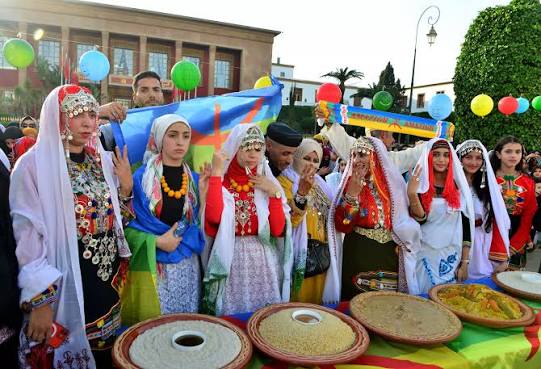
Rather than representing political boundaries, it symbolizes the shared history of Indigenous North African peoples whose cultural roots extend back thousands of years.
Preserving an Ancient Heritage for Future Generations
In recent decades, Amazigh language and culture have experienced a remarkable renaissance. Governments, educational institutions, and cultural organizations have increasingly recognized the importance of protecting this invaluable heritage. Schools now teach Amazigh languages, universities conduct research on Amazigh history and linguistics, and artists continue to celebrate Amazigh identity through literature, music, cinema, and visual arts.
This renewed appreciation ensures that future generations can continue speaking their ancestral languages while embracing modern education and technology. Digital platforms, social media, and online learning resources have also made Amazigh culture more accessible than ever before, connecting communities across continents.
Ultimately, the Amazigh language family and the Amazigh flag are far more than historical artifacts. Together, they represent a living civilization rooted in resilience, diversity, and an enduring connection to the landscapes of North Africa. From the snow-capped Atlas Mountains to the golden dunes of the Sahara, the voices of Amazigh speakers continue to preserve one of humanity’s oldest cultural traditions. Their language, stories, symbols, and values remain vibrant reminders that cultural heritage is not simply inherited—it is actively lived, protected, and passed on to future generations with pride.