
15 Stunning Moroccan Doors and Gates: Discover the Hidden Stories Behind Morocco’s Architectural Treasures
Morocco is a country filled with breathtaking landscapes, colorful souks, majestic mountains, and golden desert dunes. Yet among all its wonders, one of the country’s most captivating treasures often goes unnoticed—the magnificent Moroccan doors and gates that decorate its cities, villages, kasbahs, and ancient medinas.
Whether you’re strolling through the winding streets of Marrakech, wandering inside the medieval medina of Fes, or exploring the fortified kasbahs of southern Morocco, every doorway tells a story. These remarkable entrances are far more than decorative architectural features—they represent centuries of history, craftsmanship, spirituality, hospitality, and cultural identity.
For travelers discovering Morocco with AFC Morocco Travel, and Nomadik Morocco understanding the meaning behind these extraordinary doors adds a completely new dimension to the journey. Each carved cedar door, monumental city gate, and Amazigh village entrance reveals fascinating insights into Morocco’s rich heritage.
Let’s unlock the hidden world behind Morocco’s most beautiful doors.
Why Moroccan Doors Are More Than Just Entrances
Unlike many cultures where a front door simply provides access to a home, in Morocco the door symbolizes the boundary between two worlds.
Outside lies the vibrant public life filled with bustling markets, lively conversations, and busy streets.
Inside awaits a peaceful sanctuary where families gather, traditions are preserved, and generations live together.
This separation has been deeply rooted in Moroccan culture for centuries.
Traditional Moroccan homes, especially riads, are intentionally designed with plain exterior walls. Their true beauty remains hidden until you pass through an intricately decorated doorway into an interior courtyard overflowing with fountains, gardens, colorful tiles, and exquisite craftsmanship.
The famous Moroccan saying could almost be:
“The beauty of the house begins after the door.”

The History Behind Morocco’s Famous City Gates
Throughout history, Morocco’s imperial cities were protected by enormous defensive walls.
These walls featured monumental gateways known as Bab, meaning “gate.”
These gates were designed not only to defend cities but also to showcase the wealth and power of Morocco’s ruling dynasties.
Today, they remain among the country’s most photographed landmarks.
Bab Agnaou – Marrakech’s Royal Entrance
Built during the Almohad Dynasty in the 12th century, Bab Agnaou served as the ceremonial entrance to Marrakech’s royal district.
Unlike many city gates constructed from clay or brick, Bab Agnaou features beautifully carved sandstone decorated with:
- Floral motifs
- Quranic inscriptions
- Horseshoe arches
- Geometric carvings
Its impressive architecture still amazes visitors over 800 years later.
Bab Boujloud – The Famous Blue Gate of Fes
No visit to Fes is complete without walking through Bab Boujloud.
Often called the Blue Gate, this magnificent entrance welcomes visitors into one of the world’s oldest medieval cities.
What makes it unique?
- Blue mosaic tiles decorate the exterior.
- Green tiles face the interior medina.
- Traditional zellige craftsmanship covers every surface.
Passing beneath this gate feels like stepping back in time into a living museum.
Bab Mansour – Morocco’s Most Spectacular Gate
Located in Meknes, Bab Mansour is widely considered North Africa’s finest monumental gate.
Completed during the reign of Sultan Moulay Ismail, it combines:
- Marble columns
- Massive cedar doors
- Intricate zellige mosaics
- Islamic calligraphy
- Stunning symmetry
It remains one of Morocco’s greatest architectural masterpieces.
The Art of Moroccan Door Design
Every traditional Moroccan door is carefully handcrafted.
Master artisans spend weeks—or even months—creating a single entrance using techniques passed down through generations.
Materials commonly include:
- Atlas cedar
- Walnut wood
- Thuya wood
- Brass
- Forged iron
Each element carries symbolic meaning.

The Horseshoe Arch
One of Morocco’s most recognizable architectural features is the horseshoe arch.
Its graceful curved shape has become synonymous with Moroccan and Andalusian architecture.
Besides its beauty, it also provides structural strength.
Geometric Patterns
Because Islamic art traditionally avoids depicting living creatures, Moroccan artisans developed extraordinary geometric designs.
These include:
- Eight-pointed stars
- Twelve-pointed stars
- Floral arabesques
- Interlocking polygons
- Symmetrical mosaics
Each pattern reflects harmony, balance, and the infinite nature of creation.
The Hidden Meaning of Moroccan Door Knockers
One fascinating feature often overlooked by visitors is the traditional Moroccan door knocker.
Many old homes feature two separate knockers.
This wasn’t simply decorative.
Each produced a different sound.
The Larger Knocker
Used by male visitors.
Its deep sound alerted the family that a man had arrived.
The Smaller Knocker
Used by women or children.
Its lighter tone informed household members who was outside before opening the door.
This thoughtful design respected family privacy while maintaining traditional customs.
The Secret Door Inside the Door
Many historic Moroccan homes include a small secondary entrance built directly into the main door.
Known as a khouikha, this miniature doorway allowed individuals to enter without opening the large wooden gate.
It also forced visitors to bow slightly when entering.
This subtle architectural detail symbolized humility and respect toward the household.
Moroccan Riads: Hidden Beauty Behind Modest Doors
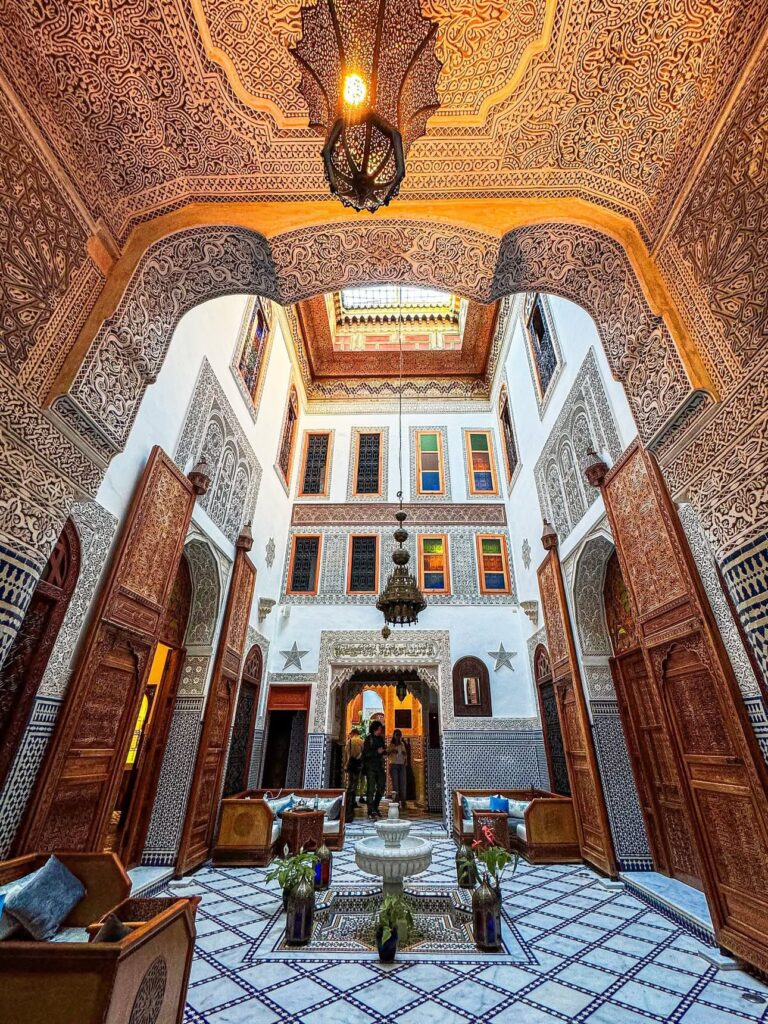
One of Morocco’s greatest architectural surprises is the traditional riad.
From the street, these homes appear simple.
Plain walls reveal almost nothing.
Then the carved wooden door opens.
Inside visitors discover:
- Marble courtyards
- Orange trees
- Fountains
- Hand-painted ceilings
- Intricate zellige tilework
- Carved plaster
- Cedar wood balconies
This dramatic contrast between exterior simplicity and interior luxury perfectly reflects Moroccan design philosophy.
Amazigh (Berber) Doors: Symbols of Identity
Travel into the Atlas Mountains or southern Morocco and you’ll discover another fascinating architectural tradition.
The indigenous Amazigh people decorate their wooden doors with symbols dating back thousands of years.
Common symbols include:
The Hand of Fatima (Khamsa)
Believed to offer protection against negative energy and the evil eye.
The Amazigh Fibula
A triangular brooch representing femininity, strength, and family.
Diamond Motifs
Often symbolize fertility and protection.
Nature Symbols
Mountain communities frequently carve:
- Trees
- Rams’ horns
- Snakes
- Stars
Each carries ancestral meanings connected to nature and spirituality.
The Kasbah Doors of Southern Morocco
South of the High Atlas Mountains, architecture changes dramatically.
Kasbahs and ksars were built using rammed earth and adobe to withstand the harsh desert climate.
Their doors were designed primarily for protection.
Characteristics include:
- Thick wooden planks
- Heavy iron studs
- Massive wooden locks
- Hand-forged hinges
- Defensive construction
These impressive entrances protected families during centuries of tribal conflicts while welcoming guests with legendary Moroccan hospitality.
The Colors of Moroccan Doors
Moroccan doors are famous for their vibrant colors.
Each shade reflects regional traditions.
Blue
Popular in Chefchaouen.
Associated with spirituality, peace, and the sky.
Green
Represents Islam and prosperity.
Frequently seen in imperial cities.
Red
Common throughout Marrakech.
Inspired by the city’s famous red earth.
Yellow
Often found in southern villages.
Provides beautiful contrast against adobe walls.
Natural pigments traditionally created these rich colors, giving every doorway its own unique personality.
Traditional Moroccan Craftsmanship
Creating a traditional Moroccan door requires remarkable skill.
Master craftsmen, known as Maalems, spend years mastering techniques including:
- Wood carving
- Brass engraving
- Iron forging
- Mosaic installation
- Cedar joinery
Every door is handmade.
No two are exactly alike.
Today, these artisans continue preserving centuries-old traditions despite increasing competition from mass-produced materials.
Supporting local craftsmen helps preserve one of Morocco’s greatest artistic legacies.
Best Places to Photograph Moroccan Doors
Photography enthusiasts will find endless inspiration throughout Morocco.
Some of the best locations include:
Marrakech Medina
Discover colorful riads and ornate palace entrances hidden throughout the old city.
Fes Medina
Perhaps Morocco’s richest collection of ancient wooden doors.
Chefchaouen
Blue-painted doors framed by whitewashed walls create unforgettable images.
Essaouira
Beautiful blue doors contrast perfectly with white Portuguese-inspired architecture.
Ait Ben Haddou
Historic kasbah entrances provide dramatic desert scenery.
Skoura Oasis
Traditional kasbah doors surrounded by palm groves offer incredible authenticity.
Preserving Morocco’s Architectural Heritage
Modern construction has changed many aspects of Moroccan architecture.
However, restoration projects throughout the country continue protecting historic doors and gateways.
Many traditional riads have been carefully restored into boutique hotels while preserving their original entrances.
Museums, heritage organizations, and skilled artisans are ensuring future generations can continue appreciating these masterpieces.
Visitors also play an important role.
By choosing locally owned accommodations, supporting artisan workshops, and respecting historic sites, travelers contribute directly to preserving Morocco’s architectural heritage.
Why Every Traveler Should Look Beyond the Door
It’s easy to admire Morocco’s colorful markets, majestic mosques, and dramatic landscapes.
But some of the country’s greatest treasures stand quietly at eye level.
Every carved cedar door represents generations of craftsmanship.
Every monumental city gate marks the entrance to centuries of history.
Every Amazigh symbol preserves ancient traditions still alive today.
Looking beyond these remarkable doors allows visitors to experience Morocco not only as tourists but as curious explorers discovering the stories hidden behind every threshold.
Travel Through Morocco with AFC Morocco Travel
At AFC Morocco Travel, every itinerary is designed to reveal Morocco’s authentic culture—not just its famous landmarks.
Whether you’re exploring the imperial cities, wandering ancient medinas, crossing the High Atlas Mountains, or visiting remote Amazigh villages, our expert local guides help you discover the fascinating stories hidden behind Morocco’s architecture, traditions, and people.
From the legendary gates of Marrakech and Fes to the handcrafted doors of the Sahara and Atlas Mountains, every journey becomes an unforgettable cultural experience.
Frequently Asked Questions
Why are Moroccan doors and gates so colorful?
Moroccan doors are painted using colors that often reflect regional identity, cultural symbolism, and traditional aesthetics. Blue symbolizes peace and spirituality, green represents prosperity, while red is closely associated with Marrakech.
Why do Moroccan doors have two knockers?
Traditional homes often feature two knockers that produce different sounds, allowing residents to identify whether the visitor is a man, woman, or child before opening the door.
What wood is commonly used for Moroccan doors and gates?
Atlas cedar is the most popular choice because of its durability, pleasant fragrance, and resistance to insects. Walnut and thuya wood are also commonly used.
Where can I see the most beautiful Moroccan doors and gates?
Some of the best locations include Marrakech, Fes, Chefchaouen, Meknes, Essaouira, Skoura, and Ait Ben Haddou.
What is a Bab in Morocco?
A Bab is a monumental gate built into the defensive walls of Morocco’s historic cities. Famous examples include Bab Agnaou, Bab Boujloud, and Bab Mansour.
Final Thoughts Moroccan Doors and Gates
Moroccan doors are much more than architectural details—they are gateways to the country’s history, artistry, and traditions. Every carved panel, colorful paint finish, and symbolic motif reflects centuries of craftsmanship and cultural heritage of Moroccan Doors and Gates. Whether you’re wandering through the ancient medinas of Fes, admiring the royal gates of Marrakech, or discovering Amazigh villages in the Atlas Mountains, take a moment to appreciate these extraordinary entrances. They are among Morocco’s most beautiful and meaningful treasures, inviting you to look beyond the threshold and experience the authentic soul of the Kingdom.